
Key facts
- Years active
- 1880–1957
- Founded by
- Heinrich Kleyer
- Country
- Germany
- Headquarters
- Frankfurt, Germany
- Legal name
- Adlerwerke vorm. Heinrich Kleyer AG
- Famous models
- Trumpf, Standard 6, Diplomat, Trumpf Junior
Adler Brand History
Adler began as a bicycle manufacturer in 1880 when Heinrich Kleyer established Adlerwerke in Frankfurt am Main. The name Adler translates to eagle in German, and this identity shaped the brand from its earliest days. By 1900 the company had entered automobile production, quickly becoming known for vehicles that carried the distinctive Adler car symbol.
The factory building in Frankfurt-Gallus still stands as a reminder of the company’s long presence in the city. Adler focused on cars until the end of World War II, after which it decided not to resume automobile construction. Full operations ceased in 1957.
Key Milestones
- 1880: Heinrich Kleyer establishes Adlerwerke in Frankfurt am Main as a bicycle producer
- 1900: Begins automobile production using the Adler name and eagle imagery
- 1902: Edmund Rumpler becomes technical director and the company starts using its own engines
- 1905: Cooperation with Clément-Bayard
- 1926: Introduction of Adler Standard 6 equipped with the first hydraulic brakes on a Continental European car
- 1927-1929: Clärenore Stinnes completes the first round-the-world automobile journey in an Adler Standard 6
- 1927-1934: Production of Standard models, some with coachwork designed by Walter Gropius
- 1930-1931: Josef Ganz develops the Maikäfer prototype at Adler before the project is halted
- 1930s: Launch of front-wheel-drive Trumpf and Trumpf-Junior models with notable racing successes
- 1937: Final new model, the Adler 2.5 Liter with Jaray streamlined bodywork
- 1945: Decision made not to resume automobile manufacturing after the war
Adler Logo Evolution
1880-1900: Bicycle Era Eagle
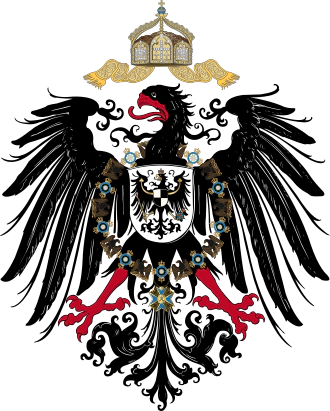
The original Adler logo appeared on bicycles during the company’s first two decades. This early design established the eagle as the central visual element tied directly to the brand name. The Adler symbol helped create a consistent identity that would carry forward into automobile production.
- Design: Stylized eagle
- Colors: Primarily black eagle motif consistent with heraldic tradition
- Changes: First version of the enduring eagle theme
- Context: Used on bicycles before the company entered the car market in 1900
1900-1926: Early Automotive Period
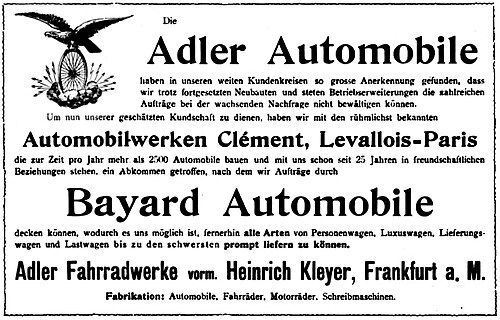
When Adler began building cars in 1900, the logo transitioned to an early automotive version. The Adler car symbol maintained the eagle motif while adapting to the new product category. This era included the 1901 Vis-à-vis 4½ HP among the first vehicles to display the badge.
- Design: Naturalistic or semi-heraldic eagle
- Colors: Black eagle with traditional heraldic coloring
- Changes: Refined for use on automobiles
- Context: Applied to vehicles with De Dion engines before the company developed its own power units
1926-1937: Standard and Trumpf Era
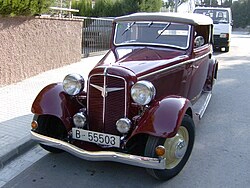
The Adler logo during this period coincided with significant technical and sporting achievements. The emblem appeared on the influential Standard 6 launched in 1926 and on the front-wheel-drive Trumpf models that followed. This version of the Adler badge gained visibility through the world tour completed by Clärenore Stinnes.
- Design: Black eagle motif
- Colors: Black eagle with red beak and tongue plus gold background elements
- Changes: Updated corporate styling during a time of increased international recognition
- Context: Used throughout the years of major publicity and motorsport activity
1937-1945: Late Pre-War Models
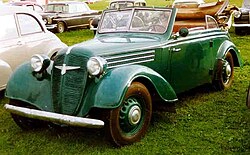
Adler introduced its last new model in 1937 with the 2.5 Liter featuring a Paul Jaray streamlined body. The Adler logo received a final update to suit the modern aesthetic of this flagship vehicle. The emblem continued on remaining production until the end of the war.
- Design: Updated eagle adapted to aerodynamic styling
- Colors: Maintained traditional black, red and gold heraldic scheme
- Changes: Refined to match the streamlined appearance of the new model
- Context: Applied to the final distinctly new Adler automobile design
1945-1957: Post-War Corporate Eagle
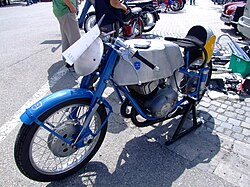
After the decision not to resume car manufacturing, Adler simplified its visual identity. The post-war Adler logo appeared on remaining product lines until the company closed in 1957. This version represented the final chapter in the brand’s seventy-seven-year history.
- Design: Further simplified corporate eagle
- Colors: Reduced detail while keeping core black eagle form
- Changes: Streamlined for corporate rather than automotive use
- Context: Used during the final years of vehicle-related activities
Adler Logo Meaning and Legacy
The Adler logo meaning stems directly from the German word for eagle. This choice connected the brand to both its name and broader German heraldic tradition from the outset. The consistent use of an eagle across more than seven decades reinforced brand cohesion between bicycles, cars and later products.
The Adler car logo gained particular prominence during the late 1920s when Clärenore Stinnes drove a Standard 6 around the world. This achievement associated the Adler emblem with German engineering capability on a global stage. The various versions of the Adler symbol tracked the company’s evolution from bicycle maker to respected automobile manufacturer.
Today the former Adler factory in Frankfurt remains a physical link to this history. While the company no longer exists, its logo history illustrates how a simple symbolic connection to the eagle created a lasting visual identity that spanned multiple eras of transportation design. The evolution of the Adler logo reflects changing design tastes while maintaining the core eagle element chosen by founder Heinrich Kleyer in 1880.