Key facts
- Years active
- 1955–1968
- Founded by
- Frank G. Nichols
- Country
- United Kingdom
- Headquarters
- Rye, United Kingdom
- Parent company
- Ken Sheppard Customised Sports Cars
- Famous models
- Courier, Mk IV, Mk VI, McLaren-Elva
Brand History
Frank G. Nichols established the Elva brand in 1955 in Bexhill-on-Sea, East Sussex with the goal of producing affordable, lightweight sports and racing cars. The company later relocated its operations to Hastings and then to Rye, Sussex. Elva focused on performance, agility, and innovative engineering, becoming influential in British club racing and selected international events during the 1950s and 1960s.
The brand timeline shows steady development. In 1958 the Elva Courier was introduced as the main road-going sports car. The Mark IV and Mark V models achieved notable racing success in 1959 at events including Sebring, Goodwood, and Marlboro. Further victories followed in both the US and UK in 1960, although financial challenges soon appeared. Nichols formed a new company in Rye in 1961 after the failure of the US distributor. During the mid-1960s Elva collaborated with McLaren, resulting in the Elva-McLaren M1A and related models. Trojan Limited acquired the Courier manufacturing rights in 1962, and Ken Sheppard Customised Sports Cars took over production from Trojan in 1965, continuing it until it ended in 1968.
Milestone Timeline
- 1955: Company founded by Frank G. Nichols
- 1958: Introduction of the Elva Courier road car
- 1959-1960: Mark IV and Mark V racing success at Sebring, Goodwood, and Marlboro
- 1961: New company established in Rye
- Mid-1960s: Collaboration with McLaren on sports racing cars
- 1962: Courier manufacturing rights acquired by Trojan Limited
- 1965-1968: Production continued under Ken Sheppard Customised Sports Cars until it ended in 1968
Product Lines in Brand Evolution
Early models from 1955 to 1958, known as Mk I to Mk III, helped establish the brand’s reputation in lightweight racing. The Courier, introduced in 1958, brought racing technology to road use with its fiberglass body and tubular steel chassis. The Mk IV and Mk V of 1959-1960 featured improved aerodynamics and independent rear suspension, delivering significant competition results.
Later variants included the Mk VI, VII, and VIII produced between 1961 and 1966. These rear-engined sports racers competed successfully in international events. Elva also developed Formula Junior models such as the FJ 100 and FJ 200, demonstrating involvement in single-seater racing. The mid-1960s partnership with McLaren represented the technical peak, producing high-performance sports racing cars.
Elva Logo Evolution
1955 – 1960s: Classic Era
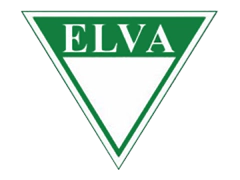
The Elva emblem remained consistent throughout the company’s main production period. This design reflected the brand’s no-nonsense approach to performance and efficiency.
- Design: Minimalist inverted triangle with sharp angles and clean lines
- Colors: Striking green field with crisp white border and white lettering
- Changes: No major redesigns documented during the original company’s lifetime
- Context: Used from founding through the late 1960s across racing and road car activities
The Elva logo meaning is closely tied to the brand name, embodying speed, lightness, and racing heritage. The inverted green triangle suggests forward motion while the simple sans-serif typography reinforces a performance-focused identity.
This Elva car logo appeared on vehicles that achieved success in both British and international motorsport. The emblem’s clarity made it suitable for high-speed racing applications where instant recognition mattered.
Later references sometimes describe the Elva symbol in connection with the company’s lightweight racing heritage. Images of the original design continue to illustrate the brand’s visual identity from its most active years.
The green triangle with white “ELVA” lettering offers a clear example of 1950s British motorsport aesthetics. Its straightforward style matches the engineering philosophy that defined the marque.
Collectors and historians value accurate representations of the Elva badge from this period. The design philosophy emphasized simplicity and immediate visual impact, qualities that aligned perfectly with the cars’ lightweight construction and sporting purpose.