Key facts
- Years active
- 1902–1934
- Founded by
- Herbert H. Franklin
- Country
- United States
- Headquarters
- Syracuse, New York, United States
- Legal name
- Franklin Automobile Company
- Famous models
- Airman, Olympic, Series 11, Twelve
Brand Overview
The Franklin Automobile Company operated as an independent luxury brand until the Great Depression forced its closure. Key associate John Wilkinson helped develop early air-cooled prototypes. The company competed in the upscale segment while emphasizing reliability and low weight.
- Founded in 1902 with the first production car sold in June
- Headquarters located in Syracuse, Onondaga County, New York
- Total production reached approximately 150,000 vehicles
- Ceased operations in 1934 after only 360 cars were built that year
Brand Timeline
The company’s history includes several technical and styling milestones that directly influenced branding.
- 1902: Company established
- 1904: Record-breaking run from New York to San Francisco in under 33 days
- 1905: Engine moved to front under barrel hood
- 1911: Renault-type hood introduced
- 1921: Distinctive horse collar radiator introduced
- 1925: John Wilkinson resigns after pressure for conventional radiator
- 1928: Airman series named after Charles Lindbergh
- 1929: Peak production exceeded 14,000 cars
- 1932: Production fell below 2,000 cars
- 1933: V-12 luxury model and Olympic introduced
- 1934: Final year of operations
The Franklin logo history closely followed these radiator and styling changes.
Franklin Logo Evolution
1902-1909: Script Name Only
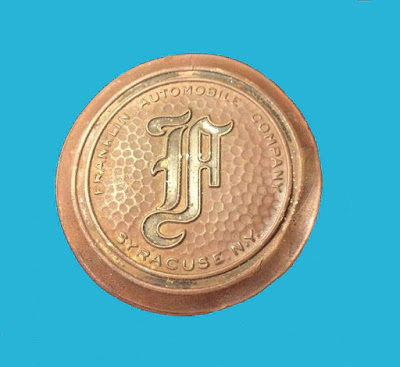
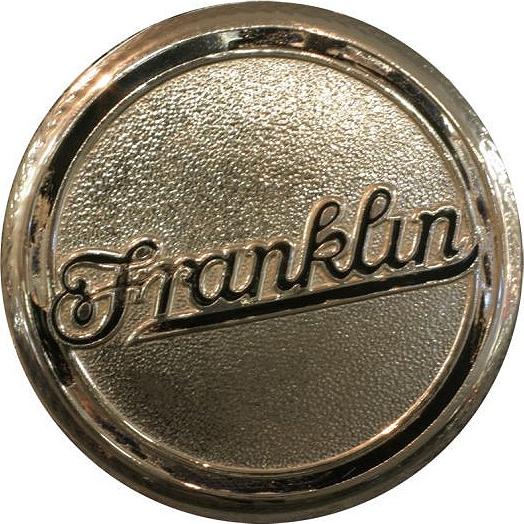
The earliest Franklin emblem consisted solely of the brand name rendered in script. This brass lettering appeared on multiple components including the radiator core, serial plates, hubcaps, step plates, and sill plates. No dedicated radiator emblem existed during this period.
- Design: Sheet brass script lettering
- Colors: Natural brass finish
- Changes: Simple name-only branding
- Context: Used on first four-cylinder runabouts
1911-1921: Renault-Type Hood
During this period the Renault-type hood eliminated the need for a radiator emblem. Script branding continued on other vehicle components. The Franklin car logo appeared primarily through the name script on non-radiator parts.
- Design: Absence of radiator emblem
- Colors: No specific emblem colors
- Changes: Hood design removed radiator decoration
- Context: Continued script use on other areas
1921-1922: Horse Collar Radiator Fist and Lightning Rods
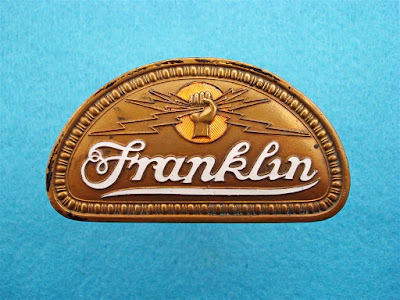
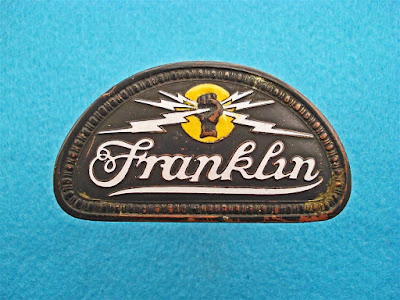
The horse collar radiator brought the first dedicated Franklin emblem. A clenched fist holding lightning rods appeared above the Franklin script, finished in enamel. This Franklin symbol marked a major styling departure.
- Design: Fist with lightning rods over script
- Colors: Enamel finish
- Changes: First radiator emblem introduced
- Context: Debut on Series 9B horse collar radiator
1923-1924: Black Enameled Fist Emblem
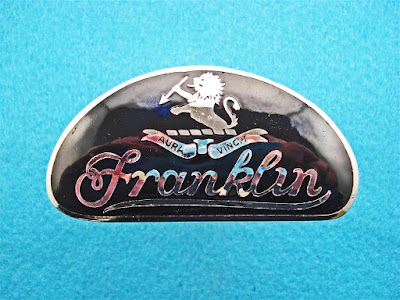
A refined version of the previous motif used full black enameling. The same fist and lightning rods design continued on the horse collar radiator. This Franklin badge represented a minor but distinct update.
- Design: Fully enameled fist and lightning rods
- Colors: Black enamel
- Changes: Complete black enameling applied
- Context: Used on Series 10A and 10B models
1925: White Capital Letters on Blue
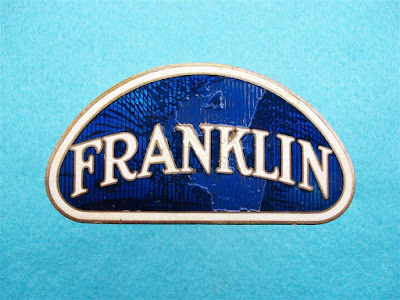
A short-lived transitional Franklin logo featured white capital letters on a blue field. This design lasted only briefly during the 1925 model year. The emblem reflected rapid changes following John Wilkinson’s resignation.
- Design: Capital letters on rectangular field
- Colors: White on blue with white border
- Changes: Complete departure from fist motif
- Context: Series 11 transitional emblem
1925-1928: Round F Motive Emblem
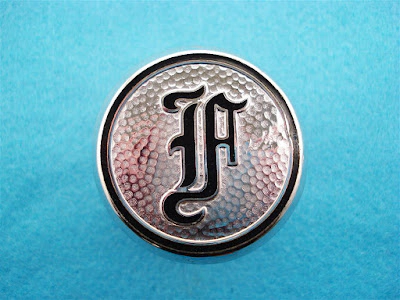
A new circular Franklin car symbol featured a black F on a round field. This black enamel emblem replaced previous designs. The shift aligned with efforts to modernize the brand’s appearance.
- Design: Small round F motif
- Colors: Black enamel with black border
- Changes: Introduction of circular format
- Context: Major redesign after conventional radiator adoption
1928-1929: Series 12 and 130 Circular Emblems
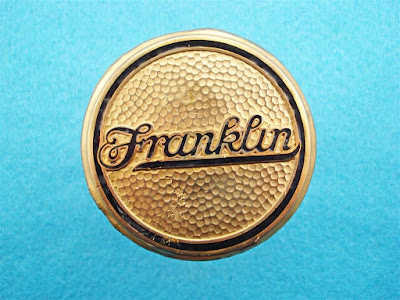
Circular emblems continued through the late 1920s with specific variants for different series. These Franklin emblems maintained the round format while production reached its peak in 1929. The designs preceded the economic downturn.
- Design: Circular radiator emblems
- Colors: Not specified in surviving records
- Changes: Size variations by series
- Context: Final pre-Depression circular designs
1930-1934: Crank Hole Emblems
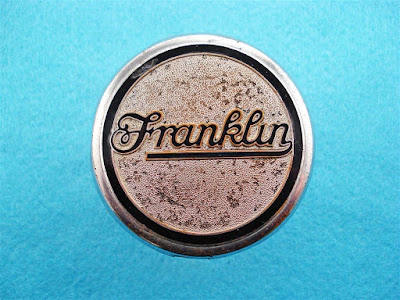
The Franklin emblem moved to cover the crank hole as radiator styling changed. These circular designs measured 62mm in diameter. This relocation marked the final phase of the company’s branding.
- Design: Emblem positioned over crank hole
- Colors: Varied by specific model series
- Changes: Relocated from top of radiator
- Context: Used during economic decline period
1932-1934: Airman Series Variant
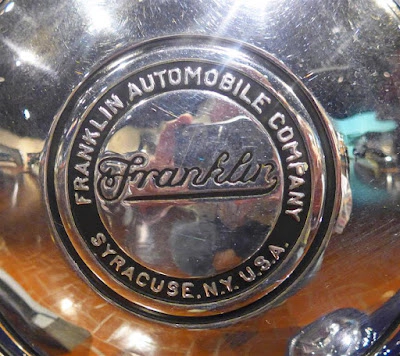
The Airman series received its own version of the crank hole Franklin badge. Named after Charles Lindbergh, these emblems accompanied special models. Production continued at reduced levels during the Great Depression.
- Design: Airman-specific crank hole emblem
- Colors: Specific to Airman trim
- Changes: Dedicated variant for named series
- Context: Introduced in 1928 but used through 1934
1933-1934: Large V12 Crank Hole Emblem
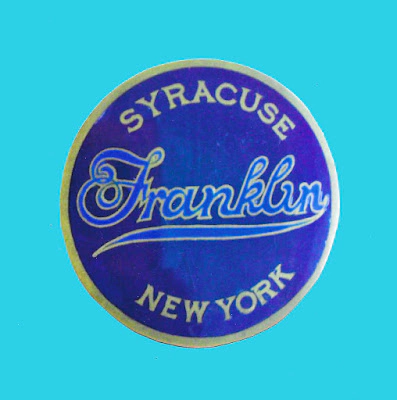
The final V-12 luxury models carried a significantly larger crank hole emblem. Measuring 102mm high by 83mm wide, this Franklin symbol appeared on roughly 200 vehicles. It represented one of the rarest Franklin car logo variants.
- Design: Oversized crank hole emblem
- Colors: Matched V-12 luxury trim
- Changes: Scaled up for flagship model
- Context: Only about 200 examples produced
Production collapsed during the Great Depression, falling from over 14,000 cars in 1929 to just 360 in 1934. The company could not sustain itself as a luxury manufacturer. Its legacy remains tied to air-cooled engineering, quality construction, and the distinctive Franklin logo evolution that tracked every major radiator redesign.