Key facts
- Years active
- 1899–2000
- Founded by
- Johann Puch
- Country
- Austria
- Headquarters
- Graz, Austria
- Parent company
- Steyr-Daimler-Puch
- Famous models
- 500, G, Alpenwagen
Brand History
Johann Puch founded the company in 1899 as Erste Steiermärkische Fahrradfabrik AG in Graz after leaving an earlier partnership. The main plant was located in the Puntigam district, later known as Einser-Werk. Initial production focused on Styria safety bicycles before the company expanded to motorcycles in 1901 and automobiles in 1904.
Key Milestones
- 1889–1899: Johann Puch begins as Humber agent and produces Styria bicycles in Graz workshop
- 1899: Establishes First Styrian Bicycle Factory AG
- 1912: Johann Puch retires with the company employing around 1,100 workers producing bicycles, motorcycles, and cars
- 1928: Merges with Austro-Daimler to form Austro-Daimler-Puchwerke
- 1934: Merges with Steyr-Werke AG to create Steyr-Daimler-Puch conglomerate
- 1949: Assembly cooperation agreement signed with Fiat
- 1957–1975: Production of Puch 500 based on Fiat 500
- 1979: Joint venture with Mercedes-Benz to build G-Class in Graz
- 1987: Major restructuring ends two-wheeler production in Graz and the Puch motorcycle company is sold to Piaggio Group
- 1997: Bicycle division including Puch sold to Grimaldi Industri group and integrated into Cycleurope
- 2011: Austrian entrepreneur Josef Faber takes control of the Puch brand
The historical assembly hall in Graz has been declared a protected monument and a Puch museum opened in 2003.
PUCH Logo Evolution
1899-1934: Independent Era
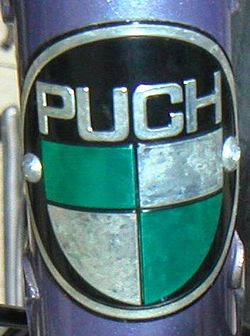
The original Puch branding was established during the early growth period from bicycles to vehicles. The PUCH logo meaning is closely tied to its regional Austrian identity.
- Design: Green and white chequered badge in a shield-like form
- Colors: Green and white derived from the Steyr town flag
- Changes: Original design introduced alongside company expansion
- Context: Used during the company’s growth as an independent manufacturer in Graz
The chequered pattern provided strong contrast suitable for both vehicles and bicycles. This early PUCH emblem maintained simple geometric styling that ensured high visibility.
1934-1987: Steyr-Daimler-Puch Era
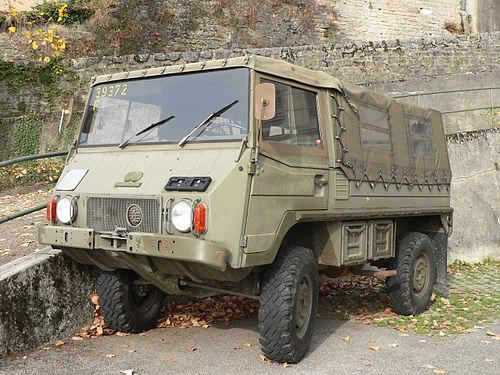
Despite multiple corporate mergers the core visual identity remained consistent. The PUCH badge continued to represent the brand within the larger Steyr-Daimler-Puch conglomerate.
- Design: Continued use of the chequered shield pattern
- Colors: Same green and white combination
- Changes: Logo survived mergers while staying tied to Puch identity
- Context: Applied throughout the conglomerate period on various products
The design proved resilient through significant ownership changes. Its connection to local heritage helped preserve brand recognition.
1987-Present: Piaggio and Cycleurope Era

After the sale to Piaggio Group the logo has been retained for legacy branding and current products. The Puch brand remains active within Cycleurope for bicycles and e-bikes.
- Design: Retained original chequered badge concept
- Colors: Green and white pattern unchanged
- Changes: Logo adapted for modern vector and PNG formats
- Context: Used on contemporary bicycle and legacy vehicle applications
This continuity supports brand recognition among enthusiasts. The simple geometric form remains effective across different media.
PUCH Symbol Legacy
The green and white chequered PUCH car logo has survived multiple ownership transitions due to its strong regional identity. Conceptually similar to the BMW badge in its use of flag-derived colors, the PUCH symbol connects directly to Steyr town heritage. The emblem appears on vehicles and as head badges on bicycles.
Modern usage includes high-resolution assets for reference. The consistent visual approach across more than a century demonstrates the strength of the original design. Current applications focus on the bicycle division as part of Cycleurope under the Piaggio Group umbrella.