Key facts
- Years active
- 2012–2018
- Founded by
- Bob Lutz, Gilbert Villarreal, Henrik Fisker
- Country
- United States
- Headquarters
- Auburn Hills, Michigan, United States
- Legal name
- VLF Automotive
- Famous models
- Destino, Force 1, Rocket, HUMVEE C-Series
VLF Automotive History
VLF Automotive began as VL Automotive in 2012, founded by former General Motors vice-chairman Bob Lutz and Gilbert Villarreal. The company first publicly displayed its initial vehicle, the Destino, at the 2013 North American International Auto Show in Detroit. A merger with GreenTech Automotive occurred in 2014, followed by significant changes in 2016 when Henrik Fisker joined the venture.
The arrival of Henrik Fisker led to the company being renamed from VL Automotive to VLF Automotive in 2016. The new name incorporated the surnames of all three principals: Villarreal, Lutz, and Fisker. In the same year, production of the Force 1 V10 was announced as a limited run of 50 units. Contract manufacturing of the HUMVEE C-Series for export markets began in 2017, followed by a partnership with Galpin Auto Sports in 2018 for the Rocket V8 project. The merged entity with GreenTech Automotive filed for bankruptcy in 2018. The official website became non-operational by 2025, though the brand remains listed as active through 2020 in some records.
Key Milestones
- 2012: VL Automotive founded by Bob Lutz and Gilbert Villarreal
- 2013: Destino revealed at Detroit auto show
- 2014: Merger with GreenTech Automotive
- 2016: Henrik Fisker joins and company renamed to VLF Automotive
- 2016: Force 1 V10 production announced
- 2017: HUMVEE C-Series contract production starts
- 2018: Rocket V8 partnership with Galpin Auto Sports
- 2018: GreenTech Automotive declares bankruptcy
Vlf Logo Evolution
The Vlf logo has remained consistent since the 2016 renaming of the company, reflecting the final brand identity built around its three founders.
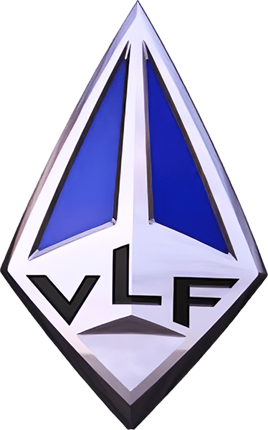
2016 – Present: VLF Emblem
The current Vlf logo features a modern three-dimensional design that symbolizes performance and forward progress. This emblem was adopted following the involvement of Henrik Fisker and the subsequent name change to VLF Automotive. Its visual elements directly tie into the company’s narrative of American high-end coachbuilding.
- Design: Central diamond-like shape with sharp geometric lines forming an abstract upward-pointing arrow
- Colors: Deep blue at the top fading to white at the bottom with silver or grey border accents
- Changes: Integrated the combined founder initials into a single cohesive mark upon the 2016 renaming
- Context: Created to represent precision and modernity in limited-production vehicle manufacturing
This Vlf car logo continues to serve as the primary identifier for the brand across its vehicle projects. The stylized VLF badge integrates the letter V into the lower point of the diamond while positioning LF to the right in a sleek sans-serif typeface.
Vehicles and Coachbuilt Models
VLF Automotive has produced several notable coachbuilt vehicles tied to its corporate evolution. The Destino, first shown in 2013 under the original VL name, is a four-door sedan derived from the Fisker Karma platform but equipped with a 6.2-liter V8 gasoline engine producing 638 horsepower. Production faced delays due to restructuring.
The Force 1 V10 debuted in 2016 as a 745-horsepower sports car based on the Dodge Viper platform. This model received a coachbuilt treatment and was limited to 50 units. The Rocket V8, developed in 2018 through a partnership with Galpin Auto Sports, transformed a Ford Mustang into a distinctive high-performance offering. Additionally, the company undertook contract production of the HUMVEE C-Series, a civilian-adapted version of the HMMWV for markets in China, Europe, and the Middle East, with limited annual output.
These projects illustrate VLF’s focus on modifying existing high-performance platforms rather than developing entirely new vehicles from the ground up. The branding and Vlf symbol appear on these limited-series automobiles, reinforcing the company’s identity in the American specialty vehicle segment.
Brand Legacy
VLF Automotive represents a chapter in modern American coachbuilding led by industry veterans with extensive experience at major manufacturers. The combination of Bob Lutz’s leadership background, Gilbert Villarreal’s technical expertise, and Henrik Fisker’s design perspective created a unique collaboration. Although the company faced challenges including the 2018 bankruptcy of its merged entity, its vehicles continue to be referenced in discussions of contemporary interpretations of American performance cars.
The Vlf logo meaning centers on the three founders whose combined expertise shaped the brand. This emblem and the associated Vlf car symbol remain visible on the various models produced during the company’s active years, preserving a record of its contribution to limited-production automotive design.