Key facts
- Years active
- 1956–1991
- Founded by
- Automobilwerk Eisenach
- Country
- Germany
- Headquarters
- Eisenach, Germany
- Legal name
- VEB Automobilwerk Eisenach
- Famous models
- 311, 353, 1.3
Brand Overview
Wartburg served as a prominent automobile brand in East Germany with its main manufacturing location in Eisenach. The marque drew its name from Wartburg Castle that overlooks the town. Production under the revived Wartburg name ran from 1956 to 1991 under the parent organization VEB Automobilwerk Eisenach.
The brand traces its roots to the first use of the name in 1898 with the Wartburgwagen. After being dropped in 1904 it saw a brief revival in the early 1930s before the main usage period began in 1956. The factory operated as Automobilwerk Eisenach and produced vehicles until the brand became defunct in 1991 when the facility was acquired by Opel.
Wartburg Logo Evolution
1956–1991: Classic Geometric Badge with City Silhouette
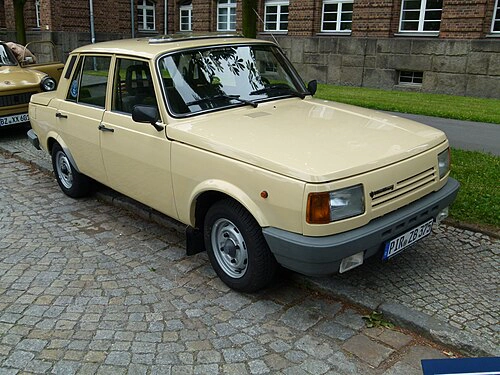
The primary Wartburg logo used during the main production period featured a sharp geometric badge. This design incorporated elements that paid tribute to the city and the brand’s legacy. The logo appeared on vehicles as well as print materials throughout the era.
- Design: Sharp geometric badge with triangular bottom and arched upper part plus elongated sides resembling wings
- Colors: Cream-beige base combined with black and silver detailing
- Changes: Adoption of the city-silhouette badge in 1956 to mark the revival of the Wartburg name on the updated IFA F9 successor
- Context: Created as an elegant tribute to the roots of the brand and the city of Eisenach while conveying style, dynamics and retro elegance
The Wartburg car logo included a black silhouette of Eisenach with roofs of different shapes and heights inside the badge. A horizontal white line with black outline crossed the city silhouette bearing the nameplate Automobilwerk Eisenach. Three letters VEB appeared under the main image.
This Wartburg symbol reflected the close ties between the automotive manufacturer and its hometown. The geometric shield and city elements formed the core of the brand’s visual identity until production ended. The design philosophy emphasized heritage through the inclusion of the city silhouette that directly represented Eisenach.
Later milestones reinforced the use of this established badge. The logo remained consistent during the start of exports to West Germany and other European countries in 1958 through the 1960s. It continued to appear on vehicles until the final years of production with the introduction of the Wartburg 1.3 model.
The Wartburg badge became historical after the factory closure in 1991. With the acquisition of the facility by Opel the brand and its emblem transitioned into automotive history. The logo history of Wartburg remains a clear example of how East German manufacturers incorporated local landmarks into their corporate identity.
Wartburg logo images from this era show the careful balance of geometric precision and illustrative elements. The combination of the shield shape, city view and typography created a distinctive mark that enthusiasts still recognize today. Several variants exist including options suitable for digital use though all maintained the core cream-beige black and silver palette.