
Key facts
- Years active
- 1992–2017
- Founded by
- Bob Lutz, Tom Gale, Roy Sjoberg
- Country
- United States
- Headquarters
- Detroit, Michigan, United States
- Parent company
- Stellantis
- Famous models
- RT/10, GTS, SRT-10, ACR
- Website
- www.dodge.com/viper.html
Dodge Viper Brand Overview
The Dodge Viper was a two-seat, front-mid-engine sports car built by Dodge from 1992 to 2017, and the Dodge Viper logo is one of the few model badges that became famous on its own. Instead of the Dodge name, the car’s nose carried a snake’s head in a shield. Three versions of that emblem were used over the car’s life, and enthusiasts know them by name: Sneaky Pete, Fangs and Stryker.
The car began as a concept at the 1989 North American International Auto Show in Detroit. Chrysler president Bob Lutz wanted a modern take on the 1960s Shelby Cobra, design chief Tom Gale’s studio shaped it, and chief engineer Roy Sjoberg led an 85-person “Team Viper” that turned the show car into a production model. A pre-production Viper RT/10 driven by Carroll Shelby paced the 1991 Indianapolis 500, and customer deliveries began in January 1992 at a price of about $52,000. The V10 engine, derived from Chrysler’s LA-series V8, was developed with help from Lamborghini, which Chrysler owned at the time.
Five generations followed: SR I (1992–1995), SR II (1996–2002), ZB I (2003–2006), ZB II (2008–2010) and VX I (2013–2017). No Vipers were built for the 2007, 2011 or 2012 model years. The last car left Detroit’s Conner Avenue Assembly in August 2017, after roughly 32,000 had been made, and the plant closed on August 31. The Viper name now belongs to Stellantis, which owns Dodge.
Dodge Viper Logo Meaning
Every Viper emblem shows the same thing: the head of a venomous snake set inside a shield-shaped frame with chrome edges. The snake gives the car its name. A car designed as a modern Cobra took the name of another deadly snake, and its V10 had a nasty reputation to match. The first cars had no traction control, no anti-lock brakes and no airbags.
What changed from one badge to the next was the snake’s attitude. Sneaky Pete looks sideways with a sly grin, Fangs stares straight at you with its fangs bared, and Stryker coils its body around the shield, ready to strike. On the car the Viper symbol sat on the nose, where a maker’s badge would normally go, and it was repeated inside the cabin.
Dodge Viper Logo Evolution
1992–2002: Sneaky Pete
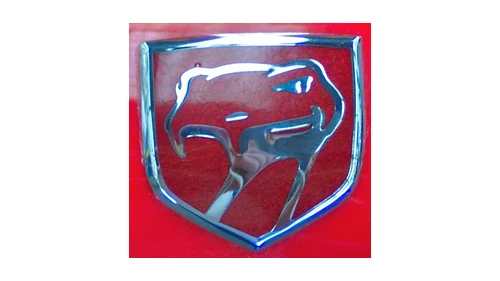
The first Viper emblem arrived with the RT/10 roadster in 1992 and stayed through the second generation, including the GTS coupe of 1996. It became known as Sneaky Pete, and it is still the old Viper logo most people picture when they think of the 1990s cars.
- Design: a snake’s head in profile with half-closed eyes and a crafty smile, drawn in chrome inside a shield
- Colors: chrome snake and frame; on the badge pictured the background is red with a scale texture
- Changes: the first emblem, so nothing to replace
- Context: used for about ten years across the SR I and SR II generations, and still common on Viper and Dodge merchandise today
2003–2010: Fangs
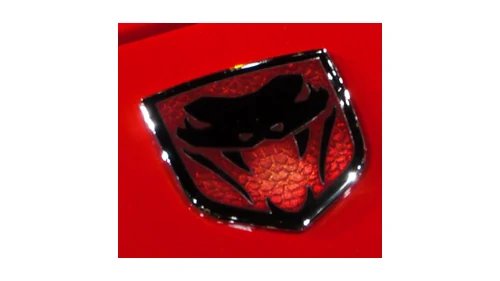
The redesigned Viper SRT-10 of 2003 came from DaimlerChrysler’s Street and Racing Technology group, with sharper bodywork by designer Osamu Shikado and a larger 8.3-liter V10. It also got a new, more aggressive badge called Fangs. Fangs stayed on the car until the ZB II generation ended after the 2010 model year.
- Design: a head-on snake face with slit eyes and two long fangs, filling a wider, lower shield
- Colors: black snake over a red scale pattern on the badge pictured; other cars wore versions with a dark background
- Changes: the side profile gave way to a front view, with the fangs replacing Sneaky Pete’s smile
- Context: introduced with the SRT-10 roadster and kept on the 2006 coupe and the 600-hp 2008–2010 cars
2013–2017: Stryker
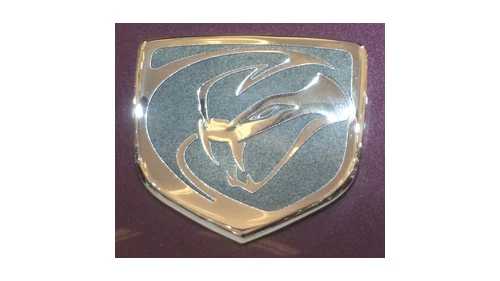
The last Viper logo was revealed in February 2012, two months before the fifth-generation car debuted at the New York auto show. Chrysler designer Vince Galante, a Viper owner himself, drew it. Galante wanted it to look a little more playful than Fangs while keeping the sinister grin of Sneaky Pete, and he worked in lines from the new car’s body. The name came from the owners: Stryker was chosen at the 2010 Viper Owners Invitational in Salt Lake City, where the new badge was first shown.
- Design: a snake with its body curled around the inside of the shield and its head turned, fangs out, ready to strike
- Colors: chrome snake on a dark textured background, with the snake picked out in black on flat graphics
- Changes: the first Viper emblem to show the coiled body as well as the head
- Context: launched on the 2013 SRT Viper and kept when the car became the Dodge Viper again for 2015, until production ended in 2017
SRT Viper and the Viper Symbol Without Dodge
For the 2013 and 2014 model years the car was sold as the SRT Viper, part of Chrysler’s attempt to turn Street and Racing Technology into a separate brand. With no Dodge name on the car, the Stryker emblem did the job of a maker’s badge on its own. In May 2014 Fiat Chrysler folded SRT back into Dodge, and from 2015 the car was the Dodge Viper again, with 645 hp and the same snake on the nose.
The Viper also carried a different name in Europe. The SR I and SR II were exported as the Chrysler Viper, and the Dodge name only arrived with the ZB I.
The 1991 and 1992 Dodge Viper
The 1991 Dodge Viper was not a production car. It was the pre-production RT/10 that Carroll Shelby drove as pace car at the 75th Indianapolis 500 in May 1991. Dodge had first picked the Japanese-built Stealth, but switched to the Viper after the United Auto Workers objected. Production began late that year, and the first 1992 Dodge Viper RT/10s reached buyers in January 1992. The 8.0-liter V10 made 400 hp, and the roadster had side-exit exhausts, a canvas roof, zip-in vinyl side windows and no exterior door handles.
FAQ
What is the Dodge Viper logo called?
There are three of them. Sneaky Pete was used from 1992 to 2002, Fangs from 2003 to 2010 and Stryker from 2013 to 2017.
What does the Viper symbol mean?
It is the head of a viper, the snake the car is named after, set in a shield. Each new design made the snake look more aggressive to match a faster generation of the car.
Who designed the Stryker Viper logo?
Chrysler designer Vince Galante created Stryker for the fifth-generation car, and Viper owners picked the name at the 2010 Viper Owners Invitational.
When did the Dodge Viper end production?
The last Viper was built in August 2017, and the Conner Avenue plant in Detroit closed on August 31, 2017. Fiat Chrysler had announced the end of the car in 2015.
Is the Dodge Viper still made?
No. Dodge’s own Viper page lists it as out of production. It covers the car’s 1991–2017 run and now offers parts, manuals and help finding used cars.