Key facts
- Founded
- 1963
- Founded by
- Ferruccio Lamborghini
- Country
- Italy
- Headquarters
- Sant'Agata Bolognese, Italy
- Parent company
- Volkswagen Group
- Legal name
- Automobili Lamborghini S.p.A.
- Famous models
- Miura, Countach, Diablo, Aventador, Huracán, Urus, Revuelto, Temerario
- Slogan
- “Driving Humans Beyond”
- Website
- www.lamborghini.com
What is the Lamborghini logo?
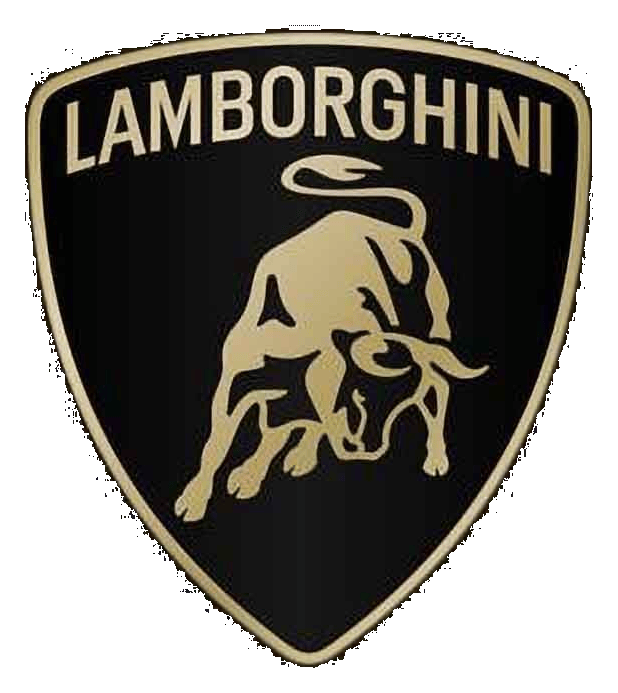
The Lamborghini emblem is a black shield with a single figure, a gold bull ready to charge, and the name LAMBORGHINI in capitals across the top. The bull has been the Lamborghini symbol since the car company was founded in 1963, and the current Lamborghini logo is the flat version unveiled on March 28, 2024.
The logo of Lamborghini has three parts: the animal, the shield and the lettering. The table shows what the Lamborghini logo means, part by part, and separates documented reasons from common interpretation.
| Element | What it shows | What it stands for |
|---|---|---|
| Bull | A gold fighting bull, the only figure on the shield | Ferruccio Lamborghini’s star sign, Taurus, and his passion for bullfighting |
| Stance | Head down, preparing to charge | Usually read as power, aggression and speed (an interpretation, not a company statement) |
| Shield | A black shield, edged since 2024 by an extremely thin gold frame | A badge shape. Claims that it signals nobility or copies Ferrari’s shield have no source |
| Lettering | LAMBORGHINI in capitals across the top | The founder’s surname. The 2024 letters are broader than before |
| Gold | The animal, the lettering and the frame | The badge color since 1964 |
| Black | The field of the shield | The dominant color of the 2024 logo |
Lamborghini logo colors: gold and black
The badge is gold on black. That pairing dates from 1964, not from 1972 or 1998 as several logo sites claim, and the Diablo’s shield is the only later badge without it.
The earliest badges used other colors: a white bull on red for the 1963 prototype, then a light-blue field for the first cars. In 1990 the Diablo got a blue shield with silver-grey details.
The gold is not yellow. In the corporate identity Lamborghini launched in 2024, black and white are the primary colors, with yellow and gold as accents. The badge itself stays black and gold.
Why is the Lamborghini logo a bull?
The Lamborghini logo is a bull because of the founder. Ferruccio Lamborghini was born on April 28, 1916, under the sign of Taurus, and he was a keen follower of Spanish bullfighting. When he started his car company in 1963, the bull became the symbol of Lamborghini.
The bullfighting link has a date and a place. In 1962 Ferruccio visited the ranch of Don Eduardo Miura near Seville, a breeder of Spanish fighting bulls, and left so impressed that he settled on a raging bull as the emblem for his planned car company.
That is why the animal on the Lambo logo isn’t standing still. Lamborghini describes its stance as that of a bull getting ready to charge, and bullfighting is still central to the brand, right down to the names of its cars.
So the Lamborghini symbol is a bull, not a horse, a ram or an ox. A popular but unconfirmed story adds that Ferruccio described his own character as stubborn as a bull. The claim that he picked it to answer Ferrari’s prancing horse has no source (more in the Ferrari section below).
Lamborghini logo history: every version since 1963
Lamborghini’s own history lists seven badges: four in 1963 and 1964 alone, then the Diablo shield in 1990, the Centro Stile badge in 1998 and the flat logo of 2024. Most logo sites show a different list, with 1972 and 1974 versions the company doesn’t include.
| Version | Years | Look | Cars that wore it |
|---|---|---|---|
| Red prototype badge | 1963 | White bull on a red field | First prototype (350 GTV), briefly |
| Four-color badge | 1963 | Gold bull on light blue, name framed at the top | First production cars (350 GT) |
| Black-and-white trial | 1964 | Same design on a black-and-white field | Short-lived |
| Classic gold on black | 1964 to early 1990s | Muscular gold bull, black name on a gold band | Miura, Countach |
| Diablo shield | 1990 | Silver-grey bull on blue | Diablo |
| Centro Stile badge | 1998–2024 | Wider shield, glossy gold, gold name on black | Cars of the Audi era until 2024 |
| Flat logo | 2024–present | Flat, black dominant, thin gold frame | Announced for future cars |
Before the cars: the Lamborghini Trattori logo

The oldest emblem tied to Ferruccio’s business predates the Lamborghini logo and belonged to tractors. He founded Lamborghini Trattori in Cento in 1948, and in its early years the company used a triangle divided into three sectors with the letters F, L and C: Ferruccio Lamborghini Cento.
Logo sites date it to 1952 or 1953, but the start date is unsettled, and it was never a car logo. The “1961 logo” some sites add is only a variant drawing.
1963: the red prototype badge
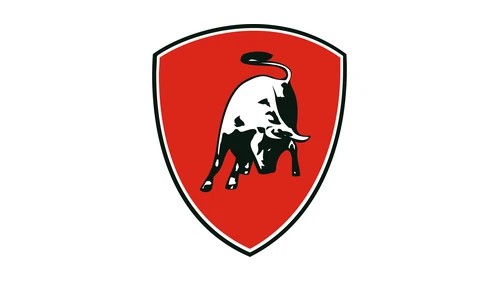
The first logo Lamborghini put on a car was never meant for production. It showed a white bull on a red field and appeared only briefly on the first prototype, the 350 GTV, in 1963, because the intended badges arrived months late. It never appeared on a Lamborghini again.
1963: the four-color badge on the first cars
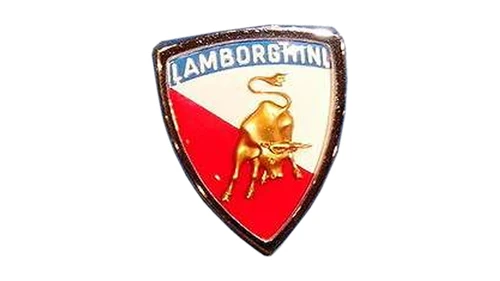
Lamborghini describes the badge planned for the cars as white and red, with a gold figure and gold lettering on a light-blue field, and says its many colors held it up for several months.
The first production cars wore a four-color Lamborghini emblem with the gold bull already in its charging stance and LAMBORGHINI in block capitals framed along the top. Slow and complex to make, it is sought after today. The company doesn’t say whether the two descriptions refer to one badge.
1964: a black-and-white trial
Next came the Lamborghini logo in black and white. In 1964 a short-lived variant kept the bull and lettering of the four-color badge but set them on a black-and-white background. Ferruccio still found it too complicated, so it was soon replaced.
1964 to the early 1990s: the classic gold bull on black
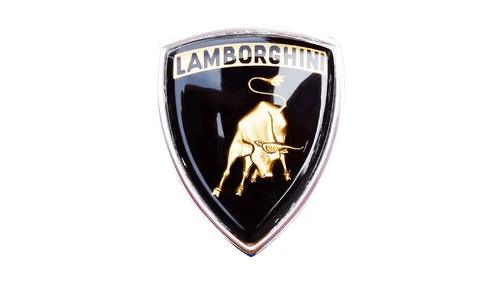
Later in 1964, the first year of mass production, the classic Lamborghini badge arrived: a more muscular, more detailed gold bull on black, with LAMBORGHINI in black capitals on a gold band across the top. It was drawn to be easy to manufacture.
It stayed in use for nearly 30 years and was fitted to the Miura and the Countach. Many logo sites split it into a “1963” and a “1972” version.
1990: the blue and silver Diablo shield
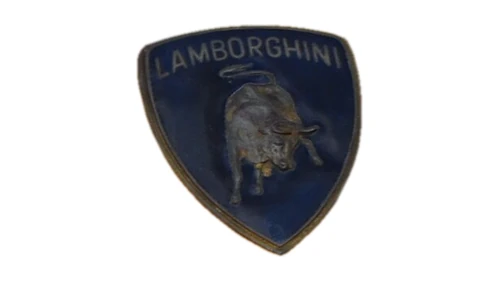
On January 21, 1990, Lamborghini unveiled the Diablo, and the car got a shield of its own. It is slightly larger than the classic badge, with a blue field and a more muscular figure and slightly redesigned lettering, both in silver-grey. There is no gold at all.
Lamborghini describes it as the Diablo’s shield, not a new logo for every model. It arrived while Chrysler owned the company, from 1987 to 1994.
1998–2024: the Centro Stile badge
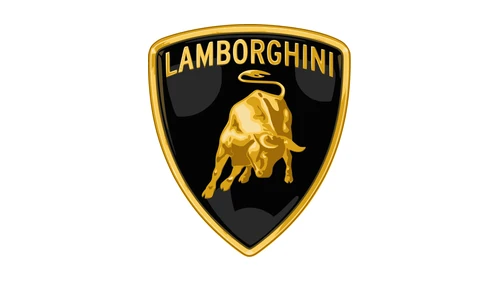
After the Volkswagen Group bought Lamborghini in 1998 and placed it under Audi, the Lamborghini car logo was redesigned. According to the company, it was the first logo project of its new in-house design center, Centro Stile.
The shield became slightly wider, and the gold figure more massive, with glossy 3D gradients. The gold band disappeared: LAMBORGHINI now sat in gold capitals, in a new font, directly on black. This badge stayed in use for 26 years.
2024–present: the new Lamborghini logo
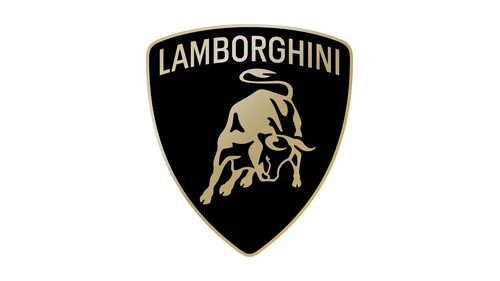
The new Lamborghini logo arrived on March 28, 2024, the first renewal in more than 20 years. It is flat and minimal, with no raised elements and few details. Black dominates, the gold is subtle, and the frame is an extremely thin gold line.
The top lettering uses a new, broader in-house typeface drawn to echo the lines and angles of the cars. For the first time, the bull can also appear without the shield on Lamborghini’s digital channels. The redesign is part of the company’s Direzione Cor Tauri strategy, and Lamborghini says the logo will appear on its future cars.
Why other sites show a 1972 and a 1974 Lamborghini logo
The 1972 and 1974 dates on many logo timelines are ownership dates, not new car badges. Ferruccio sold a majority stake to Georges-Henri Rossetti in 1972 and the rest to René Leimer in 1974, when he retired. Lamborghini’s own history shows no badge change in either year.
The “1972 medallion” those sites show is the 1964 badge with a later date. The “1974–1998 black-and-white logo” was a print mark (see the wordmark section below), while the cars kept the gold badge. Tying it to Chrysler doesn’t work either, since Chrysler owned Lamborghini only from 1987 to 1994. Claims that the logo never changed, or that there have been five logos since a 1953 founding, are also wrong.
The Lamborghini wordmark and font
No source we checked names a font for the Lamborghini logo. The name has taken three main forms: a cursive script on early cars, a bold italic wordmark in company print, and capitals across the top of the shield, redrawn in 2024 in a broader in-house typeface. Online font matches for the older lettering are guesses.
1960s: the cursive script nameplate
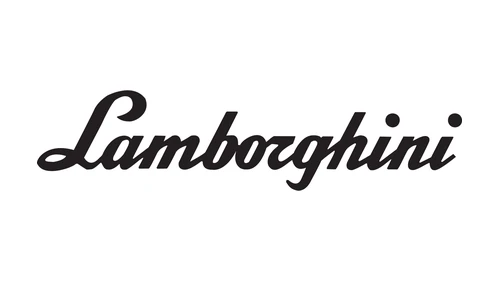
In the early years, a flowing cursive “Lamborghini” script was fitted to the cars as a raised metal nameplate, usually just below the badge, in black or silver.
From the mid-1970s: the italic print logo
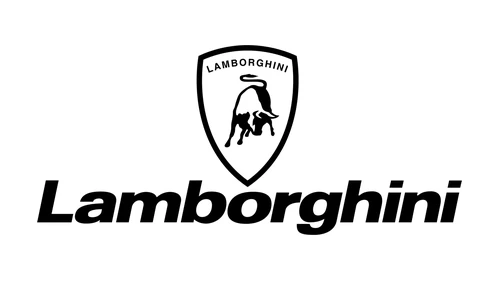
From the mid-1970s, company print materials also used a black-and-white version of the shield with a bold italic “Lamborghini” wordmark beneath it, while the cars kept the gold-on-black badge. The usual dates for this mark, 1974 to 1998, come from logo sites, not from Lamborghini.
Lamborghini vs Ferrari logo: bull vs horse
The Ferrari and Lamborghini logos are easy to tell apart: Lamborghini shows a gold charging bull on a black shield, and Ferrari a black prancing horse on yellow. So the Lamborghini logo isn’t a horse. The two emblems have separate origins, and there is no evidence that Ferruccio chose his animal to answer Enzo’s.
Ferrari’s horse was the personal emblem of Francesco Baracca, an Italian fighter pilot in World War I. Enzo Ferrari added the canary yellow of his home city, Modena, and the horse first appeared on Scuderia Ferrari race cars in 1932.
Ferrari also came first. Enzo founded Scuderia Ferrari in 1929 and began building road cars in 1947. Automobili Lamborghini followed in 1963, set up to compete with Ferrari.
What links the two brands is a story. According to a famous but unproven account, a dismissive remark from Enzo Ferrari pushed Ferruccio, then a tractor maker, to build cars of his own. The popular versions, in which Enzo told him to stick to tractors, aren’t documented.
| Lamborghini | Ferrari | |
|---|---|---|
| Animal | Bull | Horse |
| Pose | Head lowered, preparing to charge | Prancing on its hind legs, facing left |
| Where it comes from | Ferruccio’s star sign (Taurus) and bullfighting | Emblem of World War I pilot Francesco Baracca |
| First used | 1963 | 1932, on Scuderia Ferrari race cars |
| Main colors | Gold on black | Black on canary yellow, Italian tricolor at the top |
| Shape | Shield | Shield (Scuderia Ferrari) and rectangle (road cars) |
| Owner today | Audi AG, within the Volkswagen Group | Ferrari N.V., listed in New York and Milan |
Both are Italian car brands, but the companies are unrelated today: Lamborghini belongs to Audi, while Ferrari has been a separate listed company since its spin-off from Fiat Chrysler in 2016. For similar badges, see car logos with bulls and car logos with shields.
Lamborghini models named after fighting bulls
The Lamborghini logo is only half of the brand’s bullfighting theme. From the Miura of 1966 on, many of its cars have taken their names from fighting bulls, their breeders or the language of the bullring.
| Model | Where the name comes from |
|---|---|
| Miura | The fighting-bull line of breeder Don Eduardo Miura |
| Islero | The Miura bull that killed the bullfighter Manolete in 1947 |
| Espada | Spanish for “sword” |
| Urraco | A breed of fighting bull |
| Jalpa | A breed of fighting bull |
| Diablo | The Duke of Veragua’s bull, which fought in Madrid in 1869 |
| Murciélago | A bull whose life was spared in the ring in 1879 |
| Gallardo | A caste of the Spanish fighting bull |
| Reventón | A bull that beat a Mexican bullfighter in 1943 |
| Countach | Not a bull: a Piedmontese exclamation |
Later names such as Aventador and Huracán are often linked to fighting bulls too, though those stories are less well documented.
The Lamborghini car logo: which badge by era
When you spot the Lamborghini logo on car bodywork, it is the shield badge, and its colors tell you roughly when the car was built. Use these clues to date the Lamborghini car symbol on a classic or a newer model:
- White on red: only the 1963 prototype, the 350 GTV, and only briefly.
- Gold on a light-blue field: the first production cars of 1963.
- Black name on a gold band: cars from 1964 to the early 1990s, including the Miura and the Countach. Early cars often add a cursive nameplate below the Lamborghini badge.
- Silver-grey on blue: the Diablo, launched in 1990.
- Glossy gold, with gold letters directly on black: the badge used from 1998 to 2024.
- Flat shield with an extremely thin gold frame: the 2024 logo, announced for future cars.
Lamborghini logo PNG and black-and-white versions
The download button above gives you a Lamborghini logo PNG of the current 2024 logo, with the full shield on a transparent background. Other versions suit other jobs:
- Full color: the 2024 shield in black and gold, the file above.
- Without the shield: the standalone bull, a Lamborghini symbol added in 2024 for digital use.
- Black and white: the short-lived 1964 badge and the mid-1970s print mark.
- Older badges: the 1964 gold-on-black badge and the glossy 1998–2024 badge, which many sites still present as current.
Looking for a Lamborghini logo photo or PNG of an older badge? Check its year against the timeline above, since many files online carry the unofficial 1972 and 1974 dates.
Frequently asked questions
Does Lamborghini mean bull?
No. Lamborghini is a family name, the surname of Ferruccio Lamborghini, who founded the car company in 1963, and "Lambo" is simply the short form fans use. The word itself has nothing to do with bulls. The animal on the badge came from the founder's personal interests, not from his name.
Is Lamborghini Italian or German?
Lamborghini is Italian. Automobili Lamborghini was founded in Italy on May 7, 1963, and its headquarters and main plant are still in Sant'Agata Bolognese, in the Emilia-Romagna region. The German connection is ownership, since the company belongs to Audi, part of the Volkswagen Group.
Who owns Lamborghini now?
Audi AG owns Lamborghini, which makes it part of the Volkswagen Group. VW bought the company in 1998 and put it under Audi's control, and since 2011 it has been a wholly owned Audi subsidiary. Stephan Winkelmann has been CEO since December 2020, his second term after leading the company from 2005 to 2016.
Is Lamborghini still family-owned?
No. Ferruccio Lamborghini had sold his whole stake by 1974. The company went bankrupt in 1978 and then passed through several owners, including the Mimran brothers, Chrysler from 1987, MegaTech in 1994 and the Mycom Setdco and V'Power groups in 1995, before the Volkswagen Group bought it in 1998.
Who designed the Lamborghini logo?
Ferruccio Lamborghini chose the bull himself, and the 1963 design is credited to graphic designer Paolo Rambaldi, although Lamborghini's own history names no designer. Some sites say engineer Gian Paolo Dallara drew it, but there is no evidence for that. Dallara developed the chassis of the early cars, not the badge.
What was the first Lamborghini car?
The first Lamborghini was the 350 GTV, a one-off prototype built in 1963. The first series production car was the 350 GT, shown in 1964, followed by the 400 GT in 1966. The Miura, also launched in 1966, helped popularize the mid-engine layout for road-going sports cars.
What is Lamborghini's slogan?
The closest thing to an official Lamborghini slogan is its mission statement, "Driving Humans Beyond." The company cited it in March 2024 when it launched its new logo and corporate identity, together with three brand values the redesign is meant to reflect, brave, unexpected and authentic.