Key facts
- Founded
- 1920
- Founded by
- Jujiro Matsuda
- Country
- Japan
- Headquarters
- Fuchū, Hiroshima, Japan
- Legal name
- Mazda Motor Corporation
- Famous models
- MX-5, 3, CX-5
- Slogan
- “Zoom-Zoom”
- Website
- www.mazda.com
What does the Mazda logo mean?
The Mazda symbol is the letter M drawn as a pair of soaring wings. Mazda adopted this brand symbol in 1997 and links it to continuous self-reform and growth. So the Mazda logo meaning is simple: the Mazda emblem on today’s cars is an initial and a pair of wings, not a picture of an animal.
Whether you call it the Mazda sign, badge or emblem, it has three parts:
- The M. The two wings meet in a V at the center, and together they form the M of Mazda.
- The wings. Mazda says the V-shaped wings stand for growth and improvement.
- The ring. An oval ring holds the wings. The 2025 redraw made it more circular.
Wings are not new at Mazda. The company’s 1936 “emblem of wings” also used them, next to three Ms for Mazda Motor Manufacture. For other badges built on the same idea, see car logos with wings and car logos with circles.
This page covers the Mazda car logo on the grille and tailgate, not the warning symbols on a Mazda dashboard.
The new Mazda logo (2025)
The new Mazda logo is a flat, two-dimensional version of the winged M, paired with a new wordmark. The design was trademarked in July 2024 and rolled out from 2025. So if you are asking whether Mazda is changing its logo, the change has already happened.
Mazda says the symbol’s sleek, bold form makes it easier to see on digital screens, and it calls the new wordmark modern in style. The company now picks the symbol, the wordmark or the combined brand mark to suit the place and the medium, instead of always showing them together.
What changed compared with the 2015–2025 metal-look badge:
- Finish: the bevels and polished-metal shading are gone; the new mark is flat, with no chrome effect.
- Ring: the outer ring is more circular than the earlier oval.
- Wings: the lines of the wings have the same thickness all the way along.
Mazda logo history: every version since 1920
 1920–1928
 1928
1928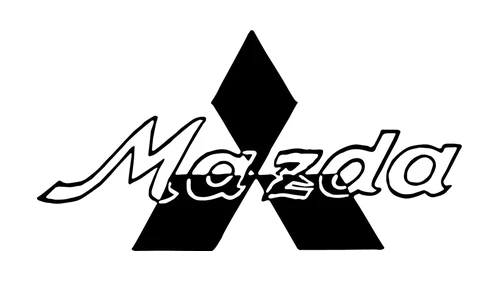 1931
1931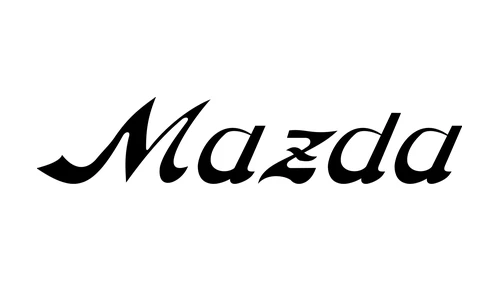 1934
1934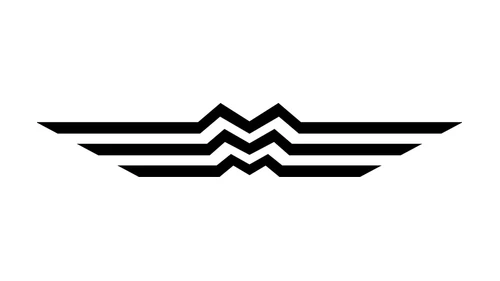 1936–1959
 1951–1972
 1954–1975
 1959–1975
 1975
1975 1991–1992
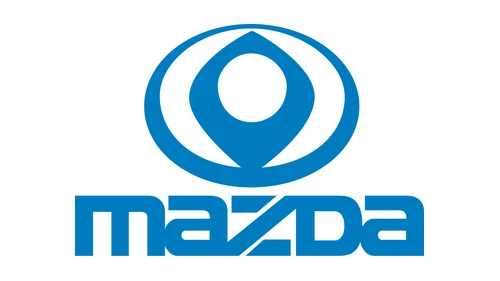 1992–1997
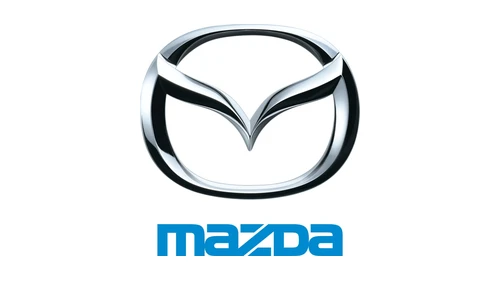 1997–2015
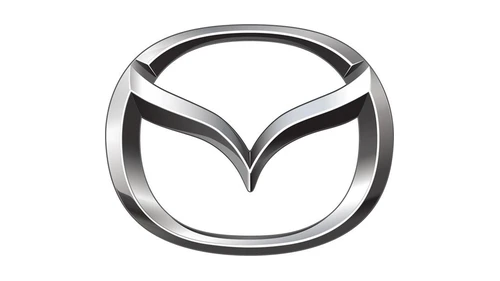 2015–2018
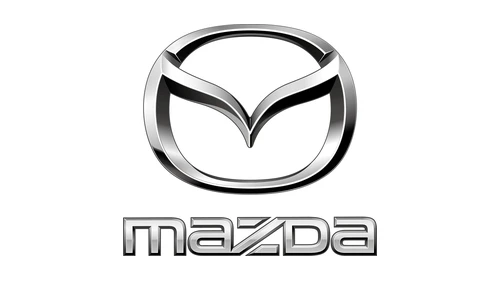 2018–2025
 2025–Present
The Mazda logo history below lists 15 marks, from the monogram of a Hiroshima cork maker to the flat symbol of 2025. Not all of these Mazda logos were car badges: some were corporate symbols and some were wordmarks, so several overlapped in time.
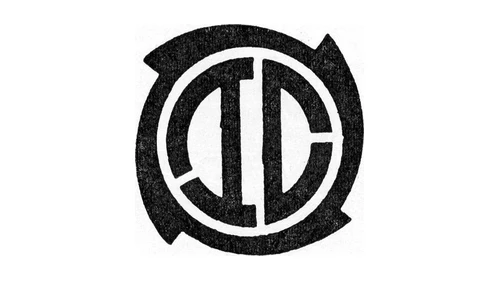
About 1920: the Toyo Cork Kogyo T and C mark
The first mark belonged to Toyo Cork Kogyo, the cork maker founded in Hiroshima on 30 January 1920. It joins a T for Toyo and a C for Cork. The notched outer edge copies the blade of a cork crusher. It is not a shuriken or a machine-tool cutter, as some logo sites claim.
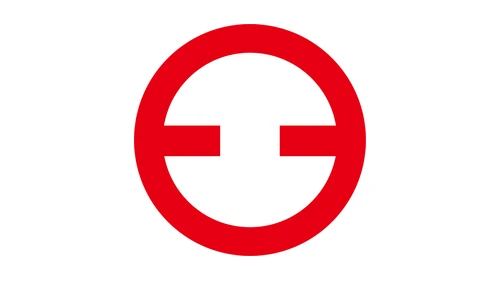
1928: the Maru-Kō mark
The company became Toyo Kogyo in 1927, and a new mark followed in 1928: the kanji 工 (kō, “manufacturing”) inside a circle. Employees called it the Maru-Kō mark. What looks like two horizontal lines is that character. Logo archives say it stayed the corporate symbol until 1975, and Mazda brought it back in its 100th-anniversary logo in 2020.
1931: Mazda-Go and the Mitsubishi diamonds
Mazda did use the Mitsubishi logo, on its very first vehicle. The Mazda-Go Type-DA, a three-wheeled truck of 1931, carried the Mazda lettering over the three diamonds of Mitsubishi. The diamonds were there because Mitsubishi sold the trucks as Mazda’s distributor. This was also the first time the Mazda name appeared on a vehicle.
1934: the italic script wordmark
From March 1934 the logo was simply the word Mazda in slanted, flowing script, with no symbol next to it. Dealer histories say this script stayed in use into the 1950s, alongside the emblems that followed. It was the first Mazda logo to show the name without another company’s mark.
1936: the emblem of wings
Mazda adopted this emblem in 1936, when it began selling its three-wheelers through its own sales network. Three Ms for Mazda Motor Manufacture are merged with the emblem of Hiroshima City, which Mazda describes as a flowing river. The long side lines are wings for agility, high speed and rapid development.
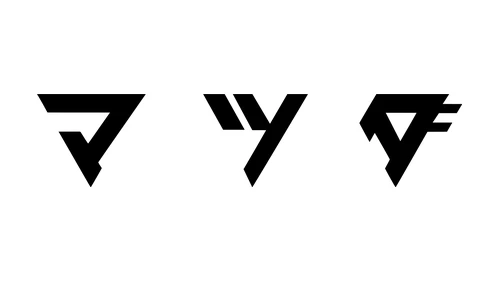
1951: the katakana logotype
Logo archives date a katakana logotype to 1951–1972. Its three characters read ma-tsu-da, the founder’s surname, and each is drawn in a downward-pointing triangle shape. That is why some sites call it a “three triangles” logo. It was a secondary logotype, not a badge on the cars.
1954: the uppercase export wordmark
For export markets, Mazda used a bold, narrow MAZDA in slanted capital letters from 1954. Like the 1934 script, it had no symbol. Dealer histories end it in 1974, and logo archives in 1975, when the new corporate wordmark took over.
1959: the stylized m
In 1959, one year before the first Mazda passenger car went on sale, the company replaced the emblem of wings with a stylized lowercase m. The outer legs of the m reach the edge of the circle around it. Mazda used this mark across all of its products.
1975: the Mazda wordmark and corporate symbol
In 1974 Mazda set up a corporate identity system with three parts: a corporate symbol, the Mazda typeface and Mazda Blue. The centerpiece, adopted in 1975, was a heavy mazda wordmark with a diagonal stroke cut through the bars of the Z. It was designed by the firm PAOS with the New York-based designer Rei Yoshimura.
1991: the diamond product emblem
From 1975 to 1991 the wordmark stood alone. In 1991 Mazda added a product emblem for its cars: a diamond inside an oval that evokes the symbol of Ahura Mazda, the source of the name. Mazda describes its parts as wings, a sun and a halo. Wikipedia describes a sun and a flame for heartfelt passion. Fans call it the “cylon” logo.
1992: the smoothed “eternal flame” emblem
Shortly afterward, around 1992, the diamond was smoothed into a rounded, flame-like shape. The usual explanation is that the first version looked too much like the diamond of Renault. Fans call the result the “eternal flame” logo. Some say it also echoes Mazda’s rotary engine, but that reading has no official source.
1997: the winged M brand symbol
The winged M arrived in 1997 as a new brand symbol, not as a redraw of the flame. The mazda wordmark sat below it in Mazda Blue, and the earlier corporate symbol was kept as the corporate mark. It has been the Mazda car symbol ever since, and every later Mazda badge keeps its shape.
2015: the polished-metal 3D version
In 2015 Mazda redrew the emblem and the corporate mark with a metallic, three-dimensional look. A grey gradient makes the mark look like polished metal, and the corporate blue was refined. The wordmark turned metallic grey with a thin blue outline. The finish was glossy, not matte.
2018: the metallic wordmark
In 2018 the emblem stayed the same, but the corporate mark was redefined as a wordmark. Its metallic texture was matched to the brand symbol. From then on, Mazda’s basic rule was to show the wordmark and the winged M together as one brand mark.
2025: the flat redesign
The current Mazda logo drops the metal effect for a flat winged M in a rounder ring, with a new wordmark in capital letters. The details are in the new Mazda logo section above.
Why did Mazda change its logo?
Most changes to the Mazda logo followed a shift in how the company sold, what it built or where the logo had to work:
- Own sales network, 1936: Mazda stopped selling through Mitsubishi, so the diamonds gave way to the emblem of wings.
- Passenger cars, 1959: the stylized m arrived a year before the first Mazda car.
- Corporate identity, 1974–1975: a design project begun in 1971 produced the wordmark. It was not a reaction to a financial crisis.
- A car emblem, 1991–1992: cars got their own emblem again, smoothed after it reportedly drew comparisons with Renault.
- One brand again, 1997: Mazda folded its Japanese sales brands Autozam, Eunos and Efini back under its own name. Henry Wallace, president from June 1996, is credited with setting out the new badge.
- One look, 2015–2018: the emblem and wordmark got a matching metal finish.
- Screens, 2025: the flat symbol is easier to see in digital environments.
Mazda logo colors, font and download
Mazda Blue is the company’s own color, part of its identity system since 1974. The current Mazda symbol and wordmark, though, are usually shown flat in black or white, with no blue and no metal effect.
- Color: the wordmark was Mazda Blue from 1975 and metallic grey from 2015. Since 2025 the logo comes in flat single-color versions.
- Font: the 1975 wordmark is custom lettering by PAOS and Rei Yoshimura, recognizable by the cut through the Z. Mazda does not name the typeface of the 2025 wordmark, so font names on logo sites are unconfirmed.
- Files: the Mazda logo PNG at the top of this page is the 2025 black symbol and wordmark on a transparent background. Mazda’s official logo files, including a white version for dark backgrounds, are in the Mazda USA media library.
What does the name Mazda mean?
Mazda is named after Ahura Mazda, a god of wisdom, intelligence and harmony worshipped in West Asia’s earliest civilization. The name also echoes the surname of the founder, Jujiro Matsuda. So the answer to “Is Mazda named after a god?” is yes, with a family name folded in.
- The idea behind it: key people at Toyo Kogyo saw Mazda as a symbol of the beginning of civilization in East and West, and of automotive civilization.
- Names that lost out: Sumera-Go (“god”) and Tenshi-Go (“angel”) were also proposed.
- First use: the name first appeared on the Mazda-Go truck of 1931, while the company kept the Toyo Kogyo name.
Mazda is one of the Japanese car brands based in Hiroshima, where it was founded in 1920.
Frequently asked questions
Is Mazda German or Japanese?
Mazda is Japanese. It was founded in Hiroshima in 1920, and its head office is still in Fuchū, Hiroshima. The company traded as Toyo Kogyo for decades and took its current legal name, Mazda Motor Corporation, only in 1984. Ford was a large shareholder for years, but Mazda never became a German or American company.
Does Ford still own Mazda?
No. Ford built up a stake in Mazda from 1974, holding 24.5% by 1979 and later raising it to 33.4%. It sold its last Mazda shares on 30 September 2015. Mazda is independent today, although Toyota bought a 5.05% stake in August 2017 as part of a business alliance.
Who founded Mazda?
Mazda's founder is Jujiro Matsuda. The business started on 30 January 1920 in Hiroshima as Toyo Cork Kogyo Co., Ltd., a factory making cork products. It moved into vehicles in the early 1930s, and Matsuda's surname is one of the two sources of the Mazda name, together with the god Ahura Mazda.
Is the Mazda symbol a bird?
No. Mazda describes its symbol as the letter M shaped like soaring wings, not as a bird. Because the wings sit inside an oval, many people see a bird in flight, a seagull or even an owl's face. Those are fan readings, not official ones.
What is Mazda's slogan?
Mazda's best-known slogan is "Zoom-Zoom," used since 2000 to describe what the company calls the "emotion of motion." In 2015 Mazda launched a campaign with the tagline "Driving Matters" alongside the redesigned MX-5. Both are advertising slogans. Neither is part of the Mazda logo, which carries only the winged M and the wordmark.
What was Mazda's first car?
Mazda's first vehicle was the Mazda-Go, a three-wheeled truck from 1931, not a car. Its first passenger car was the R360 Coupe, launched in 1960, nearly three decades later. The Carol followed in 1962. The company was still called Toyo Kogyo at the time, even though its vehicles carried the Mazda name.
Has Mazda won Le Mans?
Yes. In 1991 the 787B, a race car powered by a rotary engine, gave Mazda victory at the 24 Hours of Le Mans. It was the same year Mazda introduced its diamond product emblem, but the two events were not connected. The emblem was a branding decision, and the win came from the company's racing program.