
Key facts
- Founded
- 1926
- Founded by
- Carl Benz, Gottlieb Daimler
- Country
- Germany
- Headquarters
- Stuttgart, Germany
- Parent company
- Mercedes-Benz Group
- Legal name
- Mercedes-Benz AG
- Famous models
- S-Class, C-Class, E-Class, G-Class, GLE
- Slogan
- “The best or nothing”
- Website
- www.mercedes-benz.com
What does the Mercedes-Benz logo mean?
The three points of the Mercedes star stand for land, water and air. They express Daimler’s goal of universal motorization: Daimler engines moving people on roads, at sea and in the sky.
That Mercedes logo meaning is older than the star. Around 1897, DMG’s trademark already showed a car, a motorboat and an airship around the word “Daimler,” with an engine and a phoenix in the middle. The 1909 star put the same idea into a far simpler Mercedes symbol.
| Domain | What Daimler engines were meant to power | How the c. 1897 DMG trademark showed it |
|---|---|---|
| Land | Cars | A car |
| Water | Boats | A motorboat |
| Air | Aircraft | An airship |
Does the logo hide any other meaning? A popular theory says the points stand for the driver, the passenger and the mechanic. No Mercedes-Benz source supports it. The documented meaning is land, water and air. For other badges built on the same shapes, see car logos with stars and car logos with circles.
The story behind the Mercedes star
The Mercedes logo started as a star on a postcard. While he was technical director of the Deutz engine works in Cologne, Gottlieb Daimler drew a star over his family’s house on a picture postcard to his wife, usually dated to around 1872. He wrote that the star would one day shine over his own thriving factories.
Daimler died in 1900. In 1909, DMG’s supervisory-board chairman Alfred von Kaulla asked for a catchy new symbol, and Daimler’s sons Paul and Adolf proposed their father’s star. The key dates:
- June 24, 1909: DMG applies to protect the three-pointed star as a trademark.
- Four days later: it files a four-pointed star as well.
- 1910: the three-pointed star starts appearing on Mercedes radiators, at first without a ring.
- February 9, 1911: both stars are entered in the trademark register.
Only the three-pointed star went on the cars. The four-pointed one resurfaced decades later as the logo of Deutsche Aerospace (DASA) from 1989, and then of EADS.
Two popular claims about the star are wrong. It wasn’t adopted in the 1920s, and it wasn’t trimmed down from a five-pointed family signature: the postcard star was Gottlieb Daimler’s own drawing.
How the Benz laurel wreath joined the star
The laurel wreath came from Benz & Cie., the company of Carl Benz, not from DMG. Benz filed its name inside a laurel wreath as a trademark on August 6, 1909. In 1925 that wreath and the Daimler star were combined into one logo ahead of the 1926 merger.
1909–1926: the Benz & Cie. laurel wreath logo
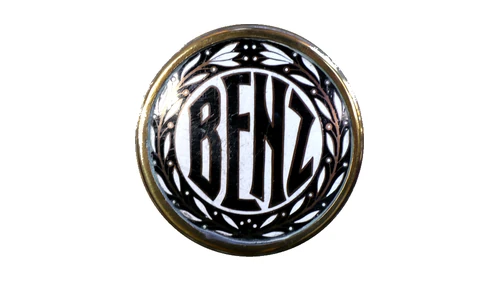
Today “Benz logo” usually means the Mercedes star, but the original Benz logo was a different mark with no star in it. From 1903 Benz & Cie. used the words “Original BENZ” inside a black toothed ring gear. The laurel version replaced it; it was entered in the register on October 10, 1910, and the wreath referred to Benz’s racing victories.
The joint star-and-wreath logo was filed on February 18, 1925, and entered on September 3, 1926, for the new Daimler-Benz AG. The merger of DMG and Benz & Cie. into Daimler-Benz AG took effect on June 28, 1926, and the Mercedes-Benz name dates from it.
The ring around the star did not come with the merger. DMG had used a ring since 1916; what 1926 added was the Benz laurel. Today Mercedes-Benz is based in Stuttgart, Germany.
Mercedes-Benz logo history: every version
The logo of Mercedes has changed in a few clear steps: the Mercedes name in 1902, the three-pointed star in 1909, a ring in 1916 and 1921, the Benz laurel wreath in 1925–26 and a slim plain ring in 1933. Since then, the Mercedes-Benz logo history has been about shading and lettering, not the symbol.
| Version | Years | What changed | Evidence |
|---|---|---|---|
| ”Mercedes” wordmark | 1902–1909 | The name alone, arched on the radiator | Filed June 23, 1902; registered September 26, 1902 |
| Three-pointed star | 1909–1916 | A star with no ring | Filed June 24, 1909; registered February 9, 1911 |
| Star in a wide ring | 1916–1921 | Ring with “Mercedes” and four small stars | DMG design of 1916 (Mercedes-Benz archive) |
| Star in a thin ring | 1921–1926 | Plain ring, also as a 3D radiator figure | Filed November 1921; entered August 2, 1923 |
| Star in a laurel wreath | 1925–26 onward | ”Mercedes” on top, “Benz” below, laurel branches | Filed February 18, 1925; entered September 3, 1926 |
| Slim black ring | 1933 to about the late 1980s | Flat black star in a thin circlet | Registered in 1933; end date unconfirmed |
| Shaded silver star | Late 1980s onward (approx.) | 3D gray shading, serif wordmark below | Logo collections only; no official date |
| Flat gray star | 2000s–2010s (approx.) | Shading removed, larger wordmark | Logo collections only; no official date |
| Current chrome star | 2010s to today | Thicker ring, thinner wordmark | Current branding; start year unconfirmed |
1902–1909: the Mercedes name before the star
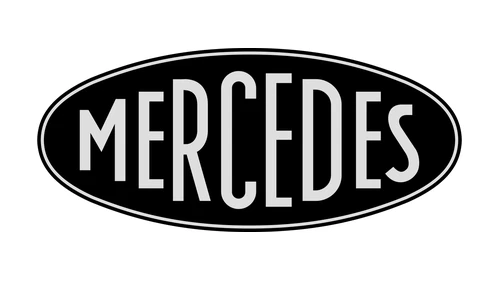
Before the star, Mercedes cars carried just the Mercedes name. DMG filed “Mercédès” as a trademark on June 23, 1902, and it was registered on September 26, 1902. Official sources describe the lettering arched across the radiator, and logo collections also show it on a horizontal oval badge. DMG needed a new name partly because it had conceded “Daimler” to Panhard & Levassor in France.
1909–1916: the original three-pointed star

The first star had no ring around it. Its drawing used light and dark facets, as if lit from the top left, so the flat mark looked three-dimensional. From 1910 it appeared in relief on Mercedes radiators, often next to separate “Mercedes” lettering. Any “1909 Mercedes badge” with a wreath is really the Benz logo shown above.
1916–1921: a wide ring with four small stars

In 1916 DMG set the star inside a wide ring. The band carried the word “Mercedes,” or the plant names Untertürkheim and Berlin-Marienfelde, together with four small stars. Modern reproductions often color it blue and burgundy, but no official source confirms the original colors.
1921–1926: the star in a thin ring
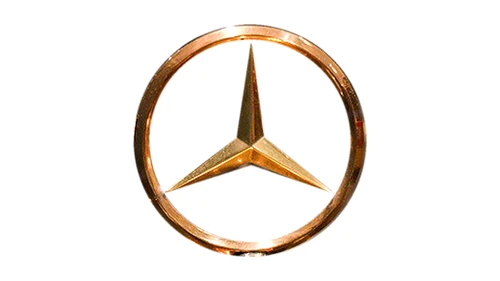
In November 1921 DMG applied to register the plain star in a thin ring as an emblem, and explicitly also as an upright figure for the radiator. The entry followed on August 2, 1923. The ring had no lettering and no small stars. This is the form that survives in today’s Mercedes-Benz logo.
1925–26 onward: the Mercedes-Benz star in a laurel wreath
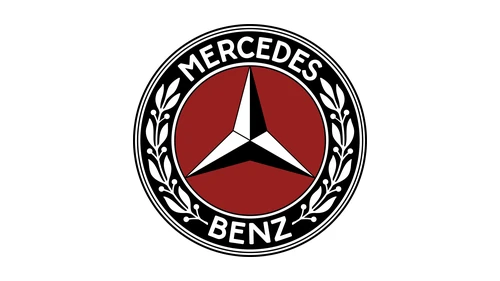
The joint Mercedes-Benz logo puts the star in a round field, with “Mercedes” arched along the top of the ring and “Benz” along the bottom. Two laurel branches, taken from the Benz mark, replace the four small stars of the 1916 design. It is still a registered trademark, and as a hood badge it stayed on most Mercedes cars into the 1990s.
1933: the slim black ring
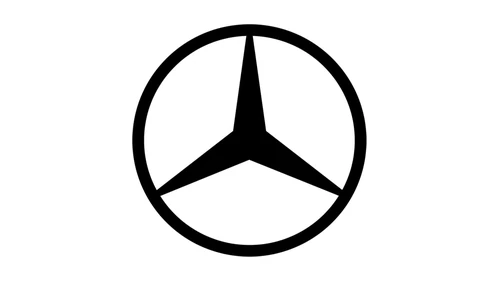
In 1933 Mercedes-Benz registered a streamlined version: the black silhouette of the star inside a slim black circlet, with no wreath and no lettering. For everyday use the wreath gave way to this plain ring, while the laurel badge stayed on car hoods. Mercedes-Benz doesn’t document when it was retired; logo collections place the change in the late 1980s.
Late 1980s (approx.): a shaded silver star with a serif wordmark
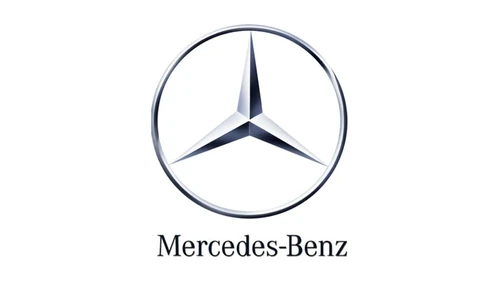
By the late 1980s a shaded silver star in a ring sat above a black serif “Mercedes-Benz” wordmark. Gray gradients gave the star a glossy, three-dimensional look. This version is documented only by logo collections, with no official date, so its timing is approximate.
2000s–2010s (approx.): a flat gray version
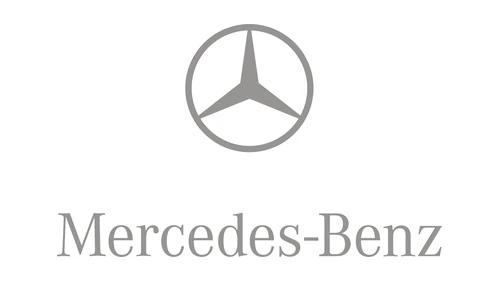
Logo collections also show a flat, light-gray version: star and ring without shading, a smaller emblem and a larger gray wordmark below it. Mercedes-Benz doesn’t document its years. What is clear is that the star and wordmark were refined in the 2000s and 2010s.
2010s to today: the new Mercedes logo
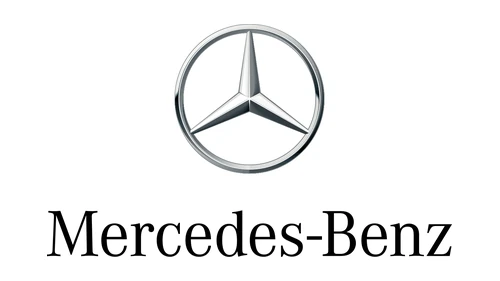
The new Mercedes logo refines the Mercedes symbol rather than replacing it. The current version shows a chrome or silver star inside a thicker, beveled ring, above a gray or black “Mercedes-Benz” wordmark with thinner strokes than before. Mercedes-Benz hasn’t published when this version started. The star itself keeps the 1921 shape.
Does Mercedes have two logos?
No. The Mercedes logo is one symbol, the three-pointed star in a ring, often called the Mercedes star. It is used in two main versions: the plain star in a ring, which you see in branding and in the grille, and the star inside the Benz laurel wreath, which survives on the badge at the base of the hood star.
Both were entered as trademarks: the plain 3-pointed star in a ring in 1923 and the laurel version in 1926. The wordmark and the sub-brand marks, above all the AMG emblem, sit next to them. On the cars, the Mercedes logo takes different physical forms:
| Form | Where you see it | Example |
|---|---|---|
| Standing star (hood ornament) | Upright on the hood, with a laurel badge at its base | S-Class of the W 140 generation |
| Grille star | Large and flat, in the center of the grille | 300 SL race car (W 194) of 1952, then SL sports cars |
| Laurel-wreath badge | Flat badge on the hood, later moved to the base of the standing star | Most Mercedes cars into the 1990s |
The Mercedes-Benz logo font and wordmark
The “Mercedes-Benz” lettering is set in Corporate A, a serif typeface that Kurt Weidemann designed for Daimler-Benz between 1985 and 1989. In the corporate version of the logo, the wordmark sits centered below the star.
The name is older than the typeface. “Mercedes-Benz” was filed as a word mark on April 25, 1925, and entered in the register on October 7, 1927. Earlier versions of the wordmark were heavier; the current one uses thinner strokes.
Mercedes-AMG logo: what AMG stands for
AMG stands for Aufrecht, Melcher and Großaspach: founders Hans Werner Aufrecht and Erhard Melcher, plus Großaspach, Aufrecht’s birthplace. The Mercedes-AMG logo is a round emblem that is usually read as local heraldry on one half and engine parts on the other.
Mercedes-AMG was founded in 1967 in Burgstall an der Murr, not in Großaspach. It moved to Affalterbach in 1976 and is still based there; Affalterbach is AMG’s home, not the Mercedes-Benz headquarters. A co-operation agreement signed in 1990 led to the first jointly developed car, the C36 AMG, in 1993. DaimlerChrysler took 51 percent of AMG on January 1, 1999, and became its sole owner on January 1, 2005. Today Mercedes-AMG is a subsidiary of Mercedes-Benz AG.
The usual explanation of the AMG logo goes like this:
- Left half: the coat of arms of Affalterbach, an apple tree by a river.
- Right half: a camshaft, a valve and a valve spring.
The Mercedes star on the car: hood ornament, grille and folding badge
The Mercedes car logo sits either upright on the hood or large in the center of the grille. Since 1957 the standing star has been spring-loaded: it folds over when hit and springs back, a design meant to protect pedestrians. That is why a Mercedes-Benz emblem on the hood moves when you push it.
Where the Mercedes-Benz symbol appears on the car:
- Radiator figure: DMG’s 1921 registration covered the star in a ring as an upright radiator figure, the ancestor of the symbol on every Benz car hood.
- Laurel badge at the base: the Mercedes-Benz badge under the standing star. Its ring turned from blue-silver to black-silver around 2016.
- Grille star: the large flat star used on SL sports cars since the 1952 300 SL race car.
- Illuminated star: some recent models offer a star that lights up.
Mercedes logo PNG and black-and-white versions
The Download button at the top of this page gives you a Mercedes logo PNG with a transparent background: a flat black star in a ring above the serif “Mercedes-Benz” wordmark. That is the Mercedes-Benz logo in black and white, which works best on light backgrounds and in print.
Which version to use:
- Flat black star, with or without the wordmark: the clean black-and-white form, close to the 1933 slim-ring design. This is the Mercedes-Benz logo PNG offered above.
- White star: use the same flat shape in white on dark backgrounds.
- Chrome or silver star: the current corporate look with 3D shading.
- Star in the laurel wreath: the historic Mercedes-Benz badge, still a registered trademark, for heritage and classic-car contexts.
Frequently asked questions
Is Mercedes named after a girl?
Yes. Mercedes was the first name of Mercédès Jellinek, born in Vienna in 1889, the daughter of Austrian businessman and Daimler dealer Emil Jellinek. He raced Daimler cars at Nice from 1899 as "Monsieur Mercédès," and in 1900 DMG agreed to put the name on its new engine. In Spanish, Mercedes means mercy or grace. The name alone was the first Mercedes logo, filed as a trademark in 1902.
Is a Benz a Mercedes?
Yes. "Benz" and "Mercedes" are both short forms of Mercedes-Benz. Benz comes from Carl Benz, whose company Benz & Cie. merged with Daimler-Motoren-Gesellschaft, the maker of Mercedes cars, in 1926. The combined company sold its cars under the Mercedes-Benz name, and people still use either half of it. The joint Mercedes-Benz logo of 1925 set the Daimler star inside the Benz laurel wreath.
Who founded Mercedes-Benz?
No single person. Mercedes-Benz was born from the 1926 merger of the companies founded by Carl Benz and Gottlieb Daimler. Both men built their first cars in 1886 without knowing each other, and Daimler founded DMG with Wilhelm Maybach in Cannstatt in 1890. Neither Maybach nor Emil Jellinek ever took over DMG, despite claims online.
What was the first Mercedes car?
The first Mercedes was a 35 hp racing car that Wilhelm Maybach designed for DMG. It was delivered to Emil Jellinek at the end of 1900 and made its name at Nice Week in March 1901. Mercedes-Benz regards it as the first modern car, and its 2019 Vision Mercedes Simplex concept was a design homage to it.
What is the Mercedes-Benz slogan?
The Mercedes-Benz slogan is "The best or nothing." The brand also calls itself the oldest luxury car brand in the world. Its roots go back to Carl Benz's Patent-Motorwagen of 1886 and to the first Mercedes, which DMG delivered in 1900, more than two decades before the two companies merged.
What does 63 mean on a Mercedes-AMG?
The 63 is a model badge, not part of the AMG logo. Mercedes-AMG models are usually badged with two numerals, and 63 is a nod to the 300 SEL 6.3. Together with the round AMG emblem and the AMG lettering, that number is the quickest way to spot an AMG.
Can I use the Mercedes logo?
The three-pointed star is a registered trademark, first filed by DMG in 1909, and Mercedes-Benz controls how it is used. Putting the Mercedes logo on products you sell or in advertising generally needs permission. Mentioning the brand in news, reviews or school work is a different case, and the same rules apply to the Mercedes-Benz logo PNG on this page. This is general information, not legal advice.
Where is Mercedes-Benz from?
Mercedes-Benz is a German brand. Mercedes-Benz AG is headquartered in Stuttgart and is a subsidiary of Mercedes-Benz Group AG, formerly Daimler AG. Today it builds cars and vans; trucks and buses have belonged to Daimler Truck since that business was spun off at the end of 2021.