Key facts
- Founded
- 1967
- Founded by
- Hans Werner Aufrecht, Erhard Melcher
- Country
- Germany
- Headquarters
- Affalterbach, Germany
- Parent company
- Mercedes-Benz Group
- Legal name
- Mercedes-AMG GmbH
- Famous models
- C 63, E 63, GT, G 63, One
- Slogan
- “Driving Performance”
- Website
- www.mercedes-amg.com
Mercedes-AMG Brand Overview
The AMG logo is two badges in one: a slanted “AMG” wordmark on the boot lid, and a round crest with an apple tree and an engine valve that says where the cars come from. Both belong to Mercedes-AMG GmbH, the high-performance arm of Mercedes-Benz, based in Affalterbach near Stuttgart.
AMG began in 1967 as a two-man racing-engine shop. Hans Werner Aufrecht and Erhard Melcher had worked on the 300 SE racing engine at Daimler-Benz until the company dropped motorsport. They carried on in their spare time, then went into business together in a former mill in Burgstall. The breakthrough came at the 1971 Spa 24 Hours, where their 300 SEL 6.8, a heavy luxury saloon, won its class and finished second overall. The company moved to Affalterbach in 1976.
In 1990 AMG signed a cooperation contract with Daimler-Benz, which put AMG parts and cars into Mercedes showrooms. The first jointly developed model, the C 36 AMG, followed in 1993. On 1 January 1999 DaimlerChrysler took a majority stake and the firm became Mercedes-AMG GmbH. The racing department went to Aufrecht’s own firm, HWA, named after his initials. Aufrecht sold his remaining shares on 1 January 2005. Today AMG builds everything from the A 35 hatchback to the AMG GT and the Formula One-engined AMG One. Its biggest engines are still assembled by hand in Affalterbach, one technician per engine, and each one carries a plaque with the builder’s signature.
What Does AMG Stand For?
AMG stands for Aufrecht, Melcher, Großaspach. The first two letters are the founders’ surnames. The G is Großaspach, the village where Aufrecht was born and where the pair first tuned engines in his house. The company’s first registered name spelled it out as an engineering office for designing and testing racing engines. In 1993 the German Patent Office recognised “AMG” as a trademark, because the three letters had become so well known.
AMG Logo Meaning
The Mercedes-AMG logo has two parts that work together:
- The ///AMG wordmark: the three letters in a wide, squared-off typeface, led by five diagonal stripes. This is the logo you see on boot lids, engine covers, wheels and steering wheels. The stripes carry no official meaning. Mercedes dealers describe them as speed lines.
- The round crest, also called the Affalterbach emblem: a split shield inside a ring. On the left is an apple tree above a wavy line of water. This comes from Affalterbach’s coat of arms, because the town’s name joins the old German affalter (apple tree) and bach (stream). On the right are a camshaft lobe, a valve and a valve spring, which stand for AMG’s engine building. Laurel branches, the old sign of victory, frame the shield. “AFFALTERBACH” runs across the top and the striped AMG wordmark sits at the bottom.
So the wordmark carries the name, and the crest tells the story behind it: a hometown and an engine workshop. The crest appears where there is room for detail, such as wheel valve caps, seat headrests and, on the newest models, the bonnet.
AMG Logo Evolution
1967–early 1990s: Plain AMG Lettering
AMG’s independent years had no stripes at all. The badge on a tuned Mercedes simply read “AMG”.
- Design: the three capital letters on their own
- Colors: no single corporate colour is documented for this period
- Changes: none yet; this is the starting point
- Context: AMG was an independent tuner selling performance parts and conversions, from the 300 SEL 6.8 racer to the 1986 E-Class “Hammer”
Early 1990s–2000s: The First ///AMG Stripes
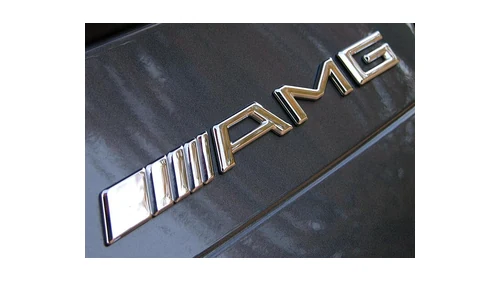
The slanted stripes appeared in front of the letters in the early 1990s, around the time AMG products started selling through Mercedes dealers. On this version the stripe block starts with one wide bar followed by narrower slashes, so it looks like it is speeding up from left to right. The badge stayed in use through the DaimlerChrysler takeover of 1999 and full ownership in 2005. Mid-2000s cars such as the E 63 and C 63 still wore it.
- Design: a wide leading bar, thinner slashes, then “AMG” in a squared typeface
- Colors: polished chrome on the cars
- Changes: first use of the stripes
- Context: AMG moved from aftermarket tuner to Mercedes’ official performance brand
2010s–present: The Five-Stripe AMG Wordmark
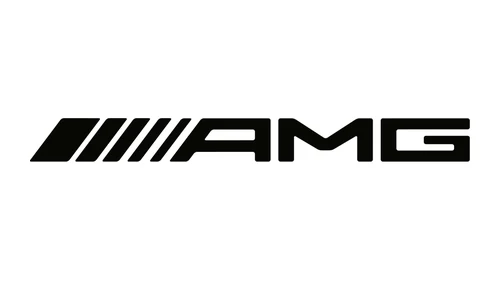
The current wordmark evens out the stripe block into five matching slashes. This is the version used in AMG’s corporate identity and on today’s cars. The naming changed around the same time. From late 2014, cars previously called, for example, “Mercedes-Benz C 63 AMG” were sold as the “Mercedes-AMG C 63”. The AMG GT, developed entirely in Affalterbach, launched under that name.
- Design: five equal parallelogram stripes ahead of the squared letters
- Colors: black or grey in print; chrome or black badges on the cars
- Changes: stripe block redrawn; “Mercedes-AMG” became the model prefix
- Context: AMG was now a full sub-brand with its own models
2022–present: The Affalterbach Crest Replaces the Star
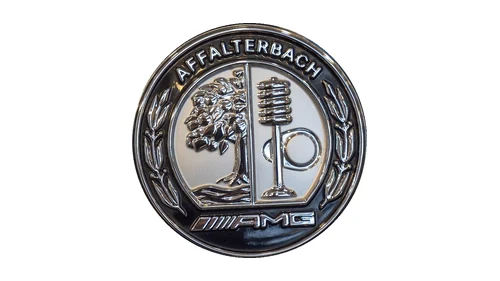
For decades the crest was a detail you found on the inside of the car. With the C 63 S E Performance, unveiled in September 2022, Mercedes said that for the first time on a Mercedes-AMG production model a round badge with the black AMG emblem replaced the Mercedes star and laurel wreath on the bonnet.
- Design: round crest with apple tree and river, cam, valve and spring, laurel branches, “AFFALTERBACH” above and ///AMG below
- Colors: black with silver detailing
- Changes: the crest moves to the bonnet in place of the three-pointed star
- Context: introduced on the C 63 S E Performance, a plug-in hybrid with a four-cylinder engine
Brabus vs AMG: Not the Same Company
Brabus is an independent tuning company. Bodo Buschmann and Klaus Brackmann founded it in Bottrop in 1977, and it is still privately owned. It is not part of AMG or Mercedes-Benz. Brabus often starts with an AMG model, such as the A 45, and modifies it further under its own name and logo. AMG cars are sold by Mercedes dealers alongside the regular range, which Brabus cars are not. More on its history: Brabus.
FAQ
What is the full form of AMG?
AMG stands for Aufrecht, Melcher, Großaspach: founders Hans Werner Aufrecht and Erhard Melcher, plus Aufrecht’s birthplace, Großaspach.
What is an AMG?
An AMG is a high-performance Mercedes developed by Mercedes-AMG GmbH in Affalterbach. It has more power, sharper handling and its own styling compared with the regular model. Current models are badged “Mercedes-AMG”, for example the Mercedes-AMG C 63.
What does the tree on the AMG logo mean?
The apple tree over a stream comes from the coat of arms of Affalterbach, AMG’s home since 1976, whose name means roughly “apple-tree stream”. The valve, spring and cam on the other half stand for engine building.
Is Brabus part of AMG?
No. Brabus is an independent tuner from Bottrop that modifies Mercedes and AMG cars. Mercedes-AMG is a wholly owned subsidiary of Mercedes-Benz.
Who owns Mercedes-AMG?
Mercedes-AMG GmbH has been a wholly owned subsidiary of the Mercedes-Benz group since 1 January 2005. Stefan Weckbach took over as CEO on 1 July 2026.