Key facts
- Founded
- 1895
- Founded by
- Václav Laurin, Václav Klement
- Country
- Czech Republic
- Headquarters
- Mladá Boleslav, Czech Republic
- Parent company
- Volkswagen Group
- Legal name
- Škoda Auto a.s.
- Famous models
- Octavia, Fabia, Superb, Kodiaq, Karoq
- Slogan
- “Let's Explore”
- Website
- skoda-auto.com
Skoda logo meaning: what the winged arrow stands for
What is the Skoda logo, exactly? A feathered wing swept back over an arrow that points right, with a small round hole near the front, all set inside a ring. It has been the Skoda car logo since the mid-1920s, and the company gives each of its parts an official meaning.
Skoda symbol meaning, part by part
Škoda ties each part of the Skoda emblem to engineering rather than to speed alone. Its own reading comes from the 2023 press release for the logo’s 100th year:
- Large circle: the global reach of Škoda and the flawless quality of its production.
- Wing: technical progress, the breadth of what Škoda makes, and worldwide sales.
- Arrow: forward-looking manufacturing and efficiency.
- Small circle: looks like an eye and stands for precision, expertise and foresight.
Wikipedia gives a slightly different reading of the Skoda logo: the arrow for speed, the wings for progress and freedom, the eye for precision, and the circle for unity, the world and harmony. The two overlap, but only the first comes from Škoda.
The design has barely moved: Škoda counts only five noticeable changes of shape or color in 100 years. Since the designer is unknown (see below), both readings are later explanations, not the artist’s own. For similar badges, see car logos with wings and car logos with arrows.
Who designed the Skoda winged arrow, and where did the idea come from?
Nobody can name the designer of the Skoda logo for certain. Škoda attributes the idea to Tomáš Maglič, then commercial director of the Škoda Works in Plzeň (Pilsen), but the company’s own historians say the actual designer may remain a mystery, and the logo may have been a group effort.
What is documented is the registration: on 15 December 1923 the Škoda Works filed the winged arrow as a trademark with the Plzeň patent office. The rest comes in three layers:
- Attributed: besides crediting Maglič, Škoda says the arrow is believed to have come out of a design competition announced by technical director Vladislav Sýkora.
- Unverified: the Czech sculptors Otakar Španiel or Otto Gutfreund may have shaped the final form, Škoda says, but nobody has confirmed it.
- Legend: Maglič was reportedly inspired by a relief in his office showing a Native American man with a distinctive feathered headdress. A second story, told on Wikipedia, has Emil Škoda bringing such a relief home from a trip to the United States. Both are stories, not records, and they cannot both be true.
Five feathers or three?
Both. Two versions were registered on the same day in 1923, one with five feathers and one with three. Škoda says the five-feather drawing came first, but the cleaner three-feather version soon became the standard and is still the Skoda symbol today.
Skoda logo history: every version from 1895 to 2016
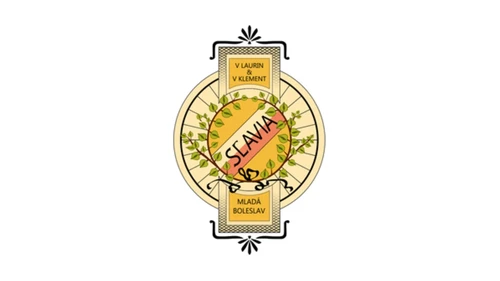 1895–1905
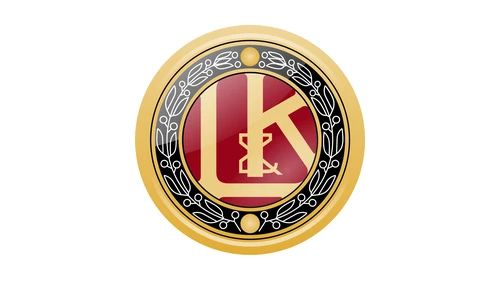 1905–1925
 1913–1929
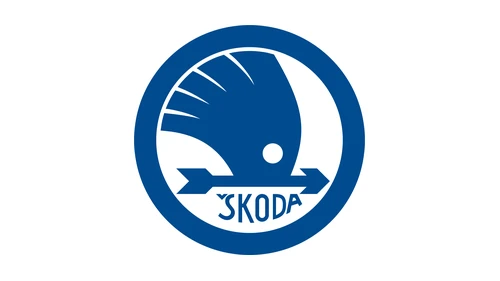 1923
1923 1925–1934
 1926–1993
 1993–1994
 1994–2011
 2011–2015
 2016–2022
 2022–Present
 2022–Present
The logo of Skoda has changed less than the company has. It started on bicycle handlebars, switched from the founders’ initials to the Škoda name after a 1925 merger, and moved from blue to green under Volkswagen, yet the winged arrow has been at the center since the mid-1920s.
1895–1905: the Slavia bicycle label
Škoda began in Mladá Boleslav in December 1895, when Václav Laurin and Václav Klement opened a bicycle repair and manufacturing workshop called Laurin & Klement. Wikipedia’s Škoda Auto article gives 1896 instead. Their bicycles were sold as Slavia, and the first logo was a label on the handlebars.
The label set “SLAVIA” diagonally inside a spoked wheel framed by lime (linden) leaves, a symbol of Slavic identity and freedom. Below the name sat “V. Laurin & V. Klement” and “Mladá Boleslav.” After the first Slavia motorcycles appeared in November 1899, a version of the label also went on the fuel tanks, roughly between 1900 and 1911.
1905–1925: Laurin & Klement initials in a laurel wreath
The company presented its first car, the Voiturette A, at the end of 1905, and a new logo came with it: a round seal built on the founders’ initials, an L and a K joined by an ampersand. For the first time a laurel wreath appeared, as a sign of success. The seal paired a red center with gold.
1913–1929: the Art Nouveau Laurin & Klement script
From 1913 the company also used a lettering-only version: “Laurin & Klement” in a flowing Art Nouveau hand. It was retired in 1929 but never fully disappeared. Škoda still puts the script on some of its top models, such as the Superb Laurin & Klement trim.
1923: the first Skoda winged arrow
The winged arrow first appeared not on cars but on locomotives built in Plzeň. It reached cars from Mladá Boleslav only after the 1925 merger, in the mid-1920s. The drawing shown here, a five-feather arrow in a thick blue ring with ŠKODA lettering underneath, comes from logo archives that date it to 1923. Škoda’s own timeline adds the lettering only in the mid-1930s, so treat that date with caution.
1925–1934: the blue Skoda oval
In 1925 Laurin & Klement, weakened by a 1924 fire and money trouble, merged with the Škoda Works of Plzeň, and the cars took the Škoda name. The first Škoda lettering came on a horizontal oval: gold script on a deep blue field, in a gold laurel frame. It shared the cars with the Laurin & Klement script until 1929, then ran alongside the winged arrow until 1934.
1926–1993: the classic blue winged arrow
This is the old Skoda logo most people picture: a three-feather arrow in a blue ring. Škoda’s timeline gives it the years 1926 to 1993, and the blue arrow stayed on cars until the mid-1990s. ŠKODA lettering joined the arrow in the mid-1930s (1937 in Škoda’s timeline, 1936 on Wikipedia). Silver and blue were the usual colors. In the 1950s and 1960s red or reversed versions also appeared, often with the wordmark.
1993–1994: blue turns green
Soon after Volkswagen took its first stake in 1991, the blue gave way to green: the change was made in December 1992 and used from 1993. A wider ring now carried the words ŠKODA and AUTO around the arrow, the first Škoda Auto logo. This all-green version was short-lived.
1994–2011: black ring, green arrow
In 1994 the outer ring turned black while the arrow stayed green, and black and green became the main Skoda logo colors. Škoda linked the green arrow to its commitment to the environment. On the cars a laurel wreath and the Škoda name sat at the bottom of the ring, and this Skoda car symbol appeared on the nose, the steering wheel, the tailgate and the wheels. Logo archives also show a glossy 3D chrome car badge from the years before 2011; print kept the flat design.
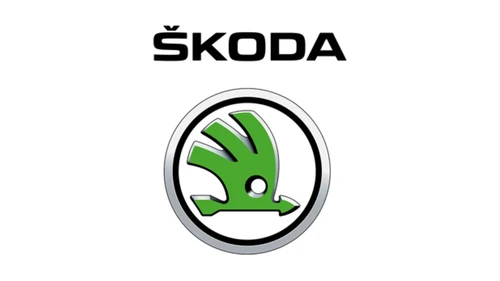
2011–2015: a thin chrome ring
Škoda showed a redesign of the Skoda car logo at the Geneva Motor Show in February 2011. The wide black ring gave way to a thin silver chrome circle, which left room for a larger arrow in a shade called Škoda Green. The laurel wreath and the lettering inside the ring were dropped. A new ŠKODA wordmark now sat above the emblem.
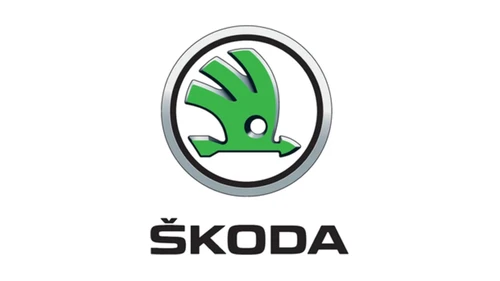
2016–2022: the name moves below
The only change to the Skoda logo in 2016 was the layout: the ŠKODA lettering moved from above the arrow to below it. The emblem itself stayed as it was in 2011.
Skoda’s new logo: the 2022 redesign
The current Skoda logo is a two-part identity unveiled on 30 August 2022: a new ŠKODA wordmark that now leads, and a flat winged arrow in a ring used on its own. It was rolled out from 2023 and has appeared on new models since 2024.
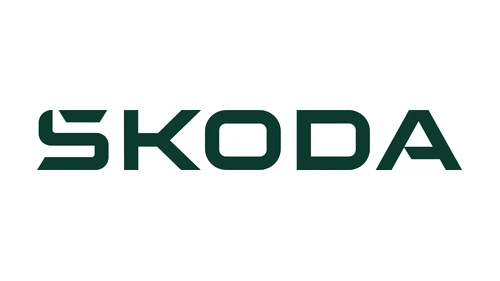
2022: the Skoda wordmark comes first
Škoda presented the new look with the Vision 7S concept car and called it the biggest change to its identity in about 30 years. The new Skoda logo puts the name first. Its custom capitals are symmetrical, pairing rounded shapes with hard edges.
The most visible detail is the háček, the small hook over the Š that marks the brand as Czech. Instead of floating above the letter, it is now built into the S itself. The spelled-out name was not entirely new: it had been on the tailgates of Škoda cars since 2018.
The flat 2022 Skoda emblem
The winged arrow stayed, but as a flat, two-dimensional mark in one color, with no chrome or shading. It is now used separately from the name, for example as an app or social media icon. The palette is built on two greens: a dark Emerald Green and a bright Electric Green.
Why Skoda changed it
Škoda gives two main reasons:
- Screens: the flat design was made for digital platforms and has more impact on phone screens.
- Recognition: its research found the written name easier to recognize and identify than the emblem.
Škoda’s announcement credits its own marketing team with the work and names no outside agency.
What does “Skoda” mean in Czech?
As a brand, Škoda is a surname: the company is named after Emil Škoda, whose Plzeň engineering works merged with Laurin & Klement in 1925. As an ordinary Czech word, “škoda” means “pity” or “shame,” and it can also mean damage. The name is not an acronym.
The Škoda Works is older than the carmaker: its Plzeň roots go back to 1859, and under the engineer Emil Škoda it grew into a large industrial group, first known for arms. That is why some sites wrongly date Škoda cars to 1859; the carmaker began as Laurin & Klement in 1895. See also Czech car brands.
Skoda logo PNG: which version you get
The Download button above gives you the current 2022 Skoda logo as a PNG with a transparent background: the flat winged arrow emblem stacked above the ŠKODA wordmark, in light green.
For other versions of the Skoda logo, go to Škoda Storyboard, the company’s media site, which publishes the official files:
- four green colorways: Electric Green on Emerald Green, Emerald Green on Electric Green, plain Electric Green and plain Emerald Green;
- white and black versions, which give you a black and white Skoda logo for single-color print;
- PDF and PNG downloads for each.
The winged arrow and the wordmark are Škoda trademarks, and this page grants no right to use them commercially.
Frequently asked questions
Is Skoda German or Czech?
Škoda is Czech. It was founded in Mladá Boleslav in 1895 as Laurin & Klement, and its headquarters are still there, in today's Czech Republic. Its parent company is Germany's Volkswagen Group, which has owned it outright since 2000. That makes it a Czech brand with a German owner, not a Polish, Russian or British one.
Is a Skoda basically an Audi?
No. Škoda and Audi are sister brands inside the Volkswagen Group, not the same company. Škoda designs, engineers and builds its own cars in the Czech Republic, but it shares platforms and parts with other group brands. The Fabia, for example, shares its platform with the Volkswagen Polo and the SEAT Ibiza.
Who is Skoda owned by?
Škoda is owned by the Volkswagen Group. The Czech government picked Volkswagen as its partner in December 1990, and Volkswagen bought in step by step: a 30% stake on 16 April 1991, 60.3% on 19 December 1994 and 70% on 11 December 1995. On 30 May 2000 it bought the remaining 30%.
Is the Skoda logo a bird or an animal?
No. Škoda describes its badge as a winged arrow: a wing, an arrow and a small circle that the company says is reminiscent of an eye. That eye and the swept-back feathers may be why some people see a bird's head in it. The only figure in the logo's history is a legend about a feathered headdress.
Are Skoda cars available in the US?
No. Škoda does not sell new cars in the United States. It was sold there from 1957 until the late 1960s, and in Canada from 1984 to 1990. Škoda sells cars in more than 100 countries, by Wikipedia's count, but North America, Japan and China are not among its markets.
Who made Skoda cars originally?
Laurin & Klement did. According to Wikipedia, bookseller Václav Klement complained in Czech to a German bicycle maker, got an answer in German, and opened a repair shop with mechanic Václav Laurin in Mladá Boleslav. The firm, founded in 1895, built its first car in 1905 and took the Škoda name after a 1925 merger.
What is Skoda's slogan?
Škoda's current brand line is "Let's Explore," introduced with its new identity in August 2022. Before that, the slogan was "Simply Clever." That phrase has not disappeared: Škoda still uses it as a label for the small practical features built into its cars.
How do you pronounce Skoda?
Say it "SHKOH-dah," with the stress on the first syllable. The háček, the small hook over the S, turns it into a "sh" sound, so the Czech pronunciation is [ˈʃkoda]. English websites often drop the háček and write Skoda, but it is the same name and is pronounced the same way.