Key facts
- Founded
- 1937
- Founded by
- German Labour Front (Deutsche Arbeitsfront)
- Country
- Germany
- Headquarters
- Wolfsburg, Germany
- Parent company
- Volkswagen Group
- Legal name
- Volkswagen AG
- Famous models
- Golf, Beetle, Passat, Tiguan, Jetta
- Website
- www.volkswagen.com
VW logo meaning: V over W in a circle
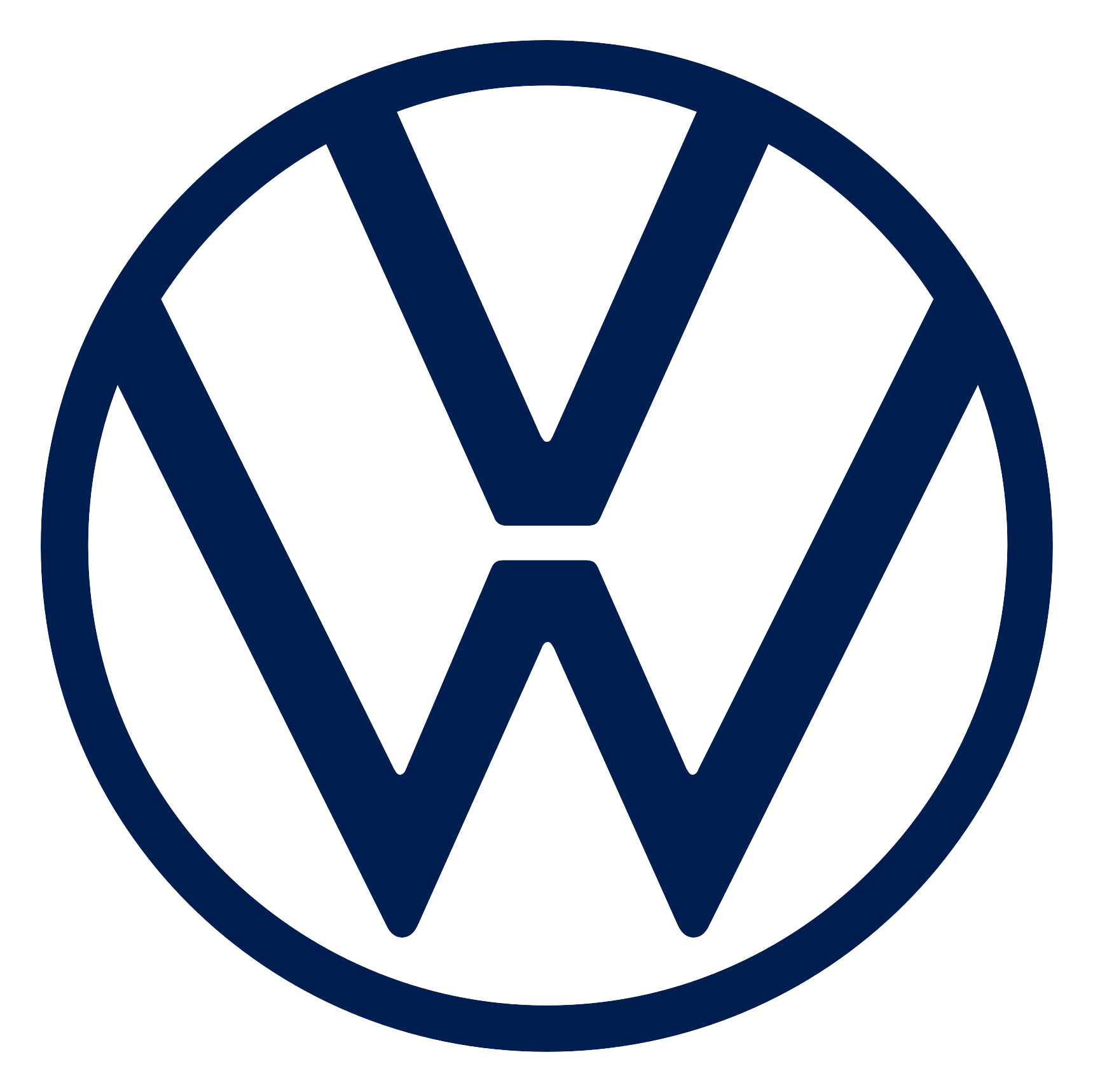
The Volkswagen symbol, usually called the VW logo, is the brand’s initials: a V set above a W inside a circle. The V stands for Volk (“people”) and the W for Wagen (“car”), so the badge is a two-letter version of the name, “people’s car.” This basic roundel had identified the brand for more than 70 years by 2019, and every badge since 1945 has been a variation of it.
Volkswagen’s own explanation covers only the colors. According to Volkswagen Australia, the blue stands for excellence, reliability and class, and the white for nobility, purity and charm. Readings such as the circle meaning unity come from dealers and fans, not from Volkswagen.
- Letters: the VW initials. On the current version the W “floats,” its lower points clear of the ring.
- Circle: a plain ring since 1945. Before that, the letters sat inside a cogwheel.
- Colors: blue and white since 1967, black and white before that. The 2019 redesign added a deep blue.
The current VW logo has no hidden symbol. The only politically loaded detail in its history was the ring of swastika-like vanes on the first emblem, dropped in 1939. For similar badges, see car logos with circles and blue car logos.
What Volkswagen means and where the logo came from
Volkswagen is German for “people’s car.” The Volks- label was not unique to cars: the Nazi regime also used it for other state-promoted goods, such as the Volksempfänger radio.
The project started in 1934, when Adolf Hitler ordered a basic car able to reach 100 km/h (62 mph) with two adults and three children aboard. It was to cost 990 Reichsmarks through a savings scheme. The car, later known as the Beetle, was engineered by Ferdinand Porsche and his design office.
The company was founded on 28 May 1937 in Berlin by the German Labour Front (Deutsche Arbeitsfront, DAF), the Nazi Party’s labor organization. Hitler ordered the people’s car and backed a state-owned factory to build it, but he is not a founder of Volkswagen in the legal sense.
On 26 May 1938 Hitler laid the factory’s foundation stone and named the car the KdF-Wagen. On 16 September 1938 the company was renamed Volkswagenwerk GmbH, and that same year the first VW emblem was filed with the Reich patent office. The factory town, founded in 1938 as Stadt des KdF-Wagens, became Wolfsburg in 1945. About 336,000 people paid into the savings scheme, but none received a car, because World War II began in 1939.
Volkswagen logo history: evolution from 1937 to today
The Volkswagen logo has had 11 main versions: 1937, 1939, 1945, 1948, 1960, 1967, 1978, 1995, 2000, 2012 and 2019. The V-over-W monogram never changed; the frame, the colors and the rendering did. Where a date rests on logo archives rather than on Volkswagen, we say so.
1937–1939: The original Volkswagen logo, a cogwheel emblem
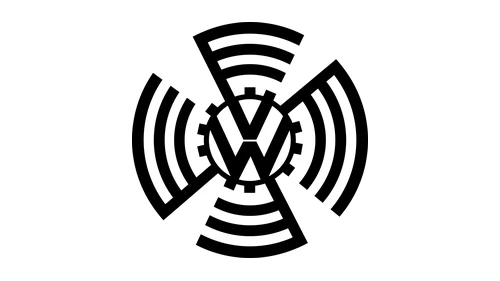
This first VW logo placed the V-over-W initials inside a stylized cogwheel. Around the cog ran angled, flag-like vanes that made the badge resemble a swastika. Reference artwork shows it in black and white, though no written source confirms the colors. It is often called the VW or Volkswagen logo 1937, after the founding year, but the first firm record comes from 1938, when it was filed with the Reich patent office.
1939–1945: Cogwheel without the vanes
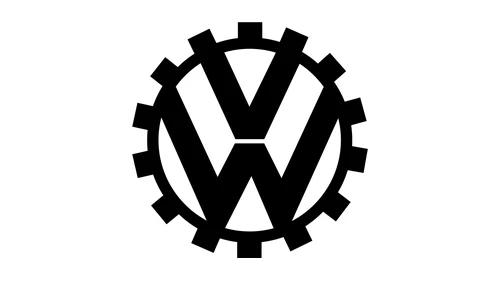
In 1939 the swastika-like vanes were removed. What remained of the VW symbol was the monogram inside a toothed cogwheel ring, still in a single dark color. This was the badge of the war years, when the plant built military vehicles such as the Kübelwagen and used about 20,000 forced laborers, according to Volkswagen’s own chronicle.
1945–1948: The plain post-war roundel
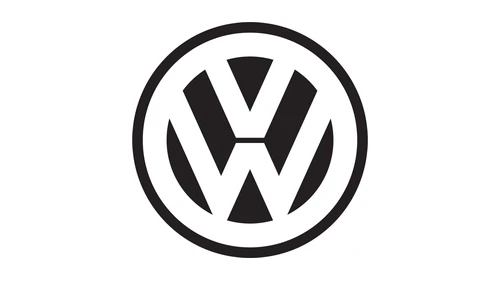
The US Army captured the factory in April 1945 and handed it to the British. Logo archives date the next change to that year: the gear teeth disappeared, leaving a smooth circle around the V and W, the shape every later badge has kept. Major Ivan Hirst restarted production, and a British Army order for 20,000 cars saved the plant. A rare red-and-white version appears in one archive, but it is thinly documented; the standard badge stayed monochrome.
1948–1960: The black-and-white roundel
In 1948 the post-war roundel was refined: the outer ring grew thicker, the V moved closer to the W, and the top of the W touched the circle again, all in black and white. In March 1948 the British offered Volkswagen to Ford free of charge, and Ford said no. A year later the first Volkswagens went on sale in the United States.
1960–1967: The square frame
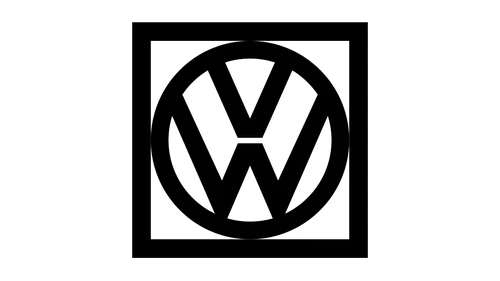
Logo archives record a 1960s version in which a thinner black roundel sat inside a square. Volkswagen’s own heritage account says only that the badge stayed black until 1967, so the square is best read as a documented variant, not an official redesign.
1967–1978: Blue arrives
Blue entered the Volkswagen logo in 1967. The square was dropped, and the letters and ring were drawn in light blue on white. Volkswagen says the aim was a friendlier global image. The brand’s reach was growing: on 17 February 1972 the Beetle passed the Ford Model T’s production record.
1978–1995: White on blue
In 1978 Volkswagen inverted the colors, putting a white V, W and ring on a solid blue disc. The flat design lasted 17 years, through the era of the Golf, sold in the US as the Rabbit. Some archives list a minor update around 1989, but they disagree on what changed, and Volkswagen’s own account skips it.
1995–2000: Deeper blue
In 1995 the blue became deeper. The badge otherwise stayed flat, with no shading. Claims that Volkswagen went 3D in 1989 and flat in 2000 come from a dealer blog and get the order backwards.
2000–2012: The first 3D logo
Around 2000 the Volkswagen logo gained depth for the first time. The blue disc got a gradient, and the letters turned into bevelled, silver-grey relief with a drop shadow and a glossy highlight across the top. Logopedia gives the launch as 28 January 2001, while other archives say 2000.
2012–2019: The chrome 3D logo
In 2012 Volkswagen introduced a fully 3D chrome logo alongside the seventh-generation Golf. The letters and outer rim looked like polished metal on a darker blue center. This is the old Volkswagen logo many cars on the road still wear. One regional Volkswagen website dates the 3D logo to 2015, but that is an error.
2019–present: The new Volkswagen logo
The new Volkswagen logo was unveiled on 9 September 2019 at the IAA motor show in Frankfurt, together with the all-electric ID.3, as the start of the “New Volkswagen.” It was designed “digital first,” to stay clear on a phone or smartwatch; marketing chief Jochen Sengpiehl called the 3D predecessor heavy and immobile. Compared with the 2012 VW logo:
- Flat instead of 3D: no chrome, gradients or shadows.
- Thinner lines: the ring and letters are drawn with lighter strokes.
- Floating W: the bottom of the W no longer touches the ring, a detail chief designer Klaus Bischoff described as making the W float.
- New color: a deep blue joins the blue and white.
The switch replaced about 70,000 logos at some 10,000 dealer and service sites in 171 markets, and added Volkswagen’s first sound logo. In the US, the new badge arrived from April 2020, starting with the 2020 Atlas Cross Sport.
Who designed the Volkswagen logo?
Nobody can be named with certainty. The Volkswagen original logo is most often credited to Porsche engineer Franz Xaver Reimspiess, who is said to have received a one-off fee of 100 Reichsmarks. Graphic artist Nikolai Borg and painter Martin Freyer have also been named as its creator. Volkswagen has said it does not know who designed it.
Borg took his claim to court. In 2005, aged 86, he sued Volkswagen in Austria, seeking recognition rather than money. Volkswagen answered that the emblem had been filed with the Reich patent office in 1938, a year before the date Borg gave for his design, and his claim was reportedly rejected.
The 2019 logo has a clearer origin. It was developed in-house by Volkswagen Design and Marketing under chief designer Klaus Bischoff, with external agencies supporting the rollout.
Volkswagen logo PNG, transparent and black-and-white versions
The Volkswagen logo PNG at the top of this page is the current 2019 design in dark blue on a transparent background, so it sits cleanly on white or any light color. Use the Download button to save the full-size file.
The flat 2019 design works in more than one color. Common Volkswagen PNG versions:
- Transparent VW logo PNG: the dark-blue file above, for web pages, documents and slides.
- White: the same outline reversed out, for dark photos and backgrounds.
- Black and white: a one-color version for print or engraving. All badges before 1967 were black and white.
Wikimedia Commons treats the 2019 logo as public domain because it is made of simple shapes and letters, but it is still a registered trademark: use it to refer to the brand, not to suggest Volkswagen’s endorsement. Volkswagen’s newsroom offers its logo images free for editorial use, with copyright held by Volkswagen AG.
On the cars, the same design is the VW badge, or emblem; about 6.2 million vehicles wearing it were built in 2019. For other makers from the same country, see our list of German car brands.
Frequently asked questions
What is the new Volkswagen logo?
The new Volkswagen logo is the flat, two-dimensional roundel the brand has used since 2019. It keeps the V over W in a circle but drops the chrome and shading of the 2012 badge, uses thinner lines and lets the W float free of the ring. It debuted with the electric ID.3 at the Frankfurt IAA show.
Does the VW logo have any hidden meanings?
No. The current VW logo shows nothing but the brand's initials inside a circle, and Volkswagen's only official interpretation concerns its blue and white colors. Talk of hidden messages usually traces back to the first emblem of 1937, whose ring of angled vanes resembled a swastika. Those vanes were removed in 1939 and never returned.
What did the VW symbol look like in 1939?
From 1939 the VW symbol was the V-over-W monogram set inside a toothed cogwheel, drawn in one dark color. It was the first emblem with the swastika-like vanes cut away, so only the gear ring and the letters remained. This version stayed in use until 1945, when a smooth circle replaced the gear teeth.
Was the VW logo used in WWII?
Yes. The cogwheel badge was the Volkswagen emblem throughout the war, from 1939 to 1945. In those years the factory produced military vehicles, including the Type 82 Kübelwagen and the Type 166 Schwimmwagen, rather than cars for the public. The gear teeth disappeared only after the war, when the British ran the plant and the plain VW circle arrived.
Does Volkswagen mean anything in German?
Yes. It joins two everyday German words, Volk ("people") and Wagen ("car" or "wagon"), so the name translates as "people's car." The short form VW takes the first letter of each word, and those two letters are the whole content of the logo, stacked with the V above the W.
Why does VW have a circle logo?
The circle goes back to 1945, when the cogwheel around the letters gave way to a smooth ring after World War II. That roundel became the template for every later version, from the 1948 black-and-white badge to the flat 2019 logo. Volkswagen has never given the circle a symbolic meaning; readings such as unity come from fans and dealers.
Is Volkswagen still German?
Yes. Volkswagen is a German brand headquartered in Wolfsburg, Lower Saxony, and part of Volkswagen AG, the German company at the head of the Volkswagen Group. The West German government and the state of Lower Saxony took control of the company in 1949, and the Volkswagen Law still caps any single shareholder's voting rights at 20 percent.
What is Volkswagen's slogan?
Since Volkswagen dropped "Das Auto." in December 2015, the company has said its logo is backed simply by the word "Volkswagen." Its most famous advertising line is "Think small," the 1959 Beetle campaign that the New York agency Doyle Dane Bernbach created for North America. A 2021 announcement of a US rename to "Voltswagen" turned out to be a hoax.
What does Das Auto mean?
"Das Auto" is German for "the car." Volkswagen used "Das Auto." as its worldwide slogan from 2007 until December 2015, when it dropped the line after the diesel emissions scandal. Herbert Diess of Volkswagen called the slogan "absolutist." Because it is a former slogan, you will no longer see it next to the VW logo in new advertising.