Key facts
- Founded
- 1903
- Founded by
- Henry Ford
- Country
- United States
- Headquarters
- Dearborn, Michigan, United States
- Legal name
- Ford Motor Company
- Famous models
- Model T, F-150, Mustang, Explorer, Focus
- Website
- www.ford.com
Ford logo meaning: the script and the Blue Oval
The Ford logo means what it says: the company name in a flowing script, inside an oval first used in 1907 as a seal of quality in British advertising. The Ford emblem is best known as the Blue Oval, and it is the Ford symbol on the grille of almost every Ford car.
The logo has two parts, and they arrived separately. Ford now groups its own heritage marks the same way, as the “Ford Script” and the “Ford Oval”.
| Element | In use since | What it is | What it means |
|---|---|---|---|
| The Ford script | 1903 on stationery, on all cars by 1906 | Custom lettering credited to C. Harold Wills | The company name. It is not Henry Ford’s signature |
| The oval | 1907 in the UK; blue on cars from late 1927 | A frame first used by Ford’s British agents | They used it to present the Ford as a “hallmark for reliability and economy” |
Ford has never published an official meaning for the blue. Trust and reliability are common readings, not company statements.
“Blue Oval” is also a nickname for the company itself. The flat version of the same design has been the Ford Motor Company logo since 2017, so the Ford car symbol on new models and the corporate mark now share one design.
Who designed the Ford logo?
No single person designed the Ford logo. The script is credited to C. Harold Wills, one of Ford’s first engineers, whom Ford describes as an engineer and draftsman. The oval came from Ford’s British agents in 1907, and the corporate oval of the mid-1960s grew out of an identity program with Unimark International.
- C. Harold Wills, script (by 1906). Wills, who had a background in lettering, is credited with the flowing script. Ford credits his lettering on its cars from the 1904 Model C to the last Model T in 1927.
- Perry, Thornton & Schreiber, first oval (1907). Ford’s agents in Britain, forerunners of Ford Motor Company Ltd, put the name inside an oval.
- Unimark International, corporate identity (mid-1960s). The design firm, founded in 1965, counted Ford among its clients. Sources disagree on who drew the oval itself, so we don’t credit it to any one Unimark partner.
- Paul Rand, rejected proposal (1966). Ford commissioned the graphic designer, but Henry Ford II turned down his obround shape and more geometric script as too radical.
- Rob Brancheau, flat badge (2023). The Ford senior designer described the flatter badge on the 2024 F-150 to Car and Driver.
Two popular stories don’t hold up. The script is often mistaken for Henry Ford’s signature, but Ford credits the lettering to Wills. And Ford has not recorded who drew the first 1903 crest.
Ford logo history: every version since 1903
The Ford logo has taken about 15 forms since 1903, but since 1910 it has been refined rather than replaced. The script has kept its basic form since the end of 1910, and the oval first framed it on a car with the 1927 Model A. The table below tracks the Ford logo evolution, showing the Ford logos through the years and where each one was used.
| Years | Version | Used on | Key change |
|---|---|---|---|
| 1903 | Script on stationery | Letters and documents | First use of the Ford script |
| 1903 – c.1906 | Art Nouveau crest | The 1903 Model A | Company name and city in a leafy border |
| 1906 – 1910 | Script with wings | All Ford cars | Long swashes on the F and d |
| 1907 | British “Hall Mark” oval | UK advertising | First oval, with FORD in block capitals |
| End of 1910 on | Revised script | Every later logo | The form still used today |
| 1911 | ”The Famous Ford Motor Cars” | Not recorded | Script inside a double oval |
| c.1912 | Plain script oval | Printed marks | Script in a single black outline |
| 1912 | ”The Universal Car” wings | Badge, briefly | First blue in a Ford mark |
| Late 1927 – 1957 | First Blue Oval | Model A radiator, then corporate use | First blue oval on a car |
| 1949 – late 1960s | Red, white and blue crest | Cars | Replaced the oval on vehicles |
| 1957 | Redrawn navy oval | Corporate | A true ellipse with bolder letters |
| Mid-1960s – 1976 | Flat corporate oval | Corporate identity | Flat, two-dimensional navy |
| 1976 – 2003 | Blue-and-silver oval | Cars, plants, products | Oval back on the vehicles |
| 2003 – 2017 | Centennial Blue Oval | Corporate to 2017, cars to 2023 | Brighter gradient for the 100th anniversary |
| 2017 – today | Flat Blue Oval | Corporate, cars from 2023 | No gradient, no chrome |
1903: the Ford script on company stationery
The Ford script is older than any badge, so Ford logo history starts on paper. From the start of 1903, the year the business was set up, Ford used its script lettering on company letters and paperwork. It was not yet on the cars: the first Model A wore the crest described below.
1903–1906: the original Ford logo, an Art Nouveau crest
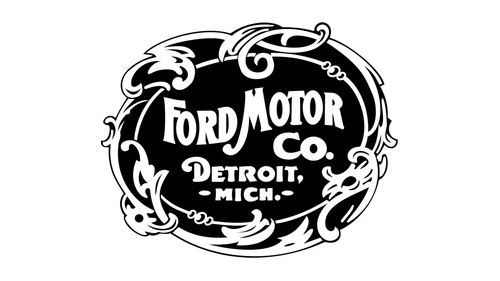
The original Ford logo on a car was an ornate crest. It went on the first production car, the 1903 Model A, and read “Ford Motor Co.” over “Detroit, Mich.” inside a curling Art Nouveau border. The first logo Ford put on a car was black and white, with no script and no blue. Ford has not recorded who drew it.
1906–1910: the “script with wings”
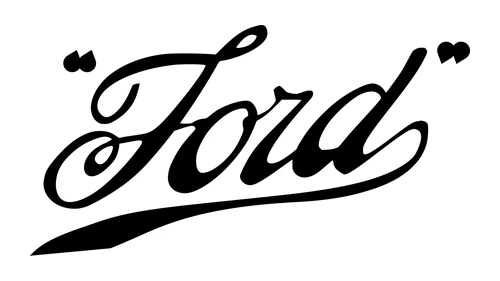
By 1906 a more elaborate script was on all Ford cars. Its long-tailed F and d earned it the name “script with wings”, and a long swash ran under the whole word. It was black, with no frame. Ford registered the script with the U.S. Patent Office in 1909 and used this form until the end of 1910.
1907: the first Ford oval, a British “Hall Mark”
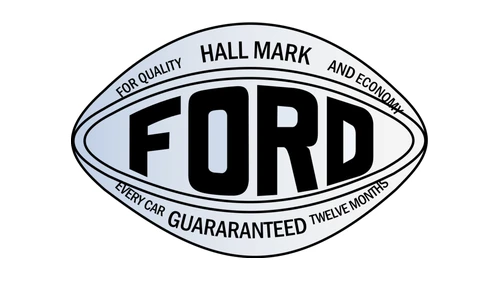
The first Ford oval was British. In 1907 Perry, Thornton & Schreiber, Ford’s agents in the UK, used an oval to sell the car as a hallmark of reliability and economy. Their silver-grey badge spelled FORD in block capitals, not the script, with “Every Car Guaranteed Twelve Months” underneath.
End of 1910: the script takes its modern form
At the end of 1910 Ford tidied the script into the shape it still uses. The long under-swash and the quotation marks went away, and the crossbar of the F turned into a small curl. Every oval since then has carried this lettering, redrawn in detail but not redesigned.
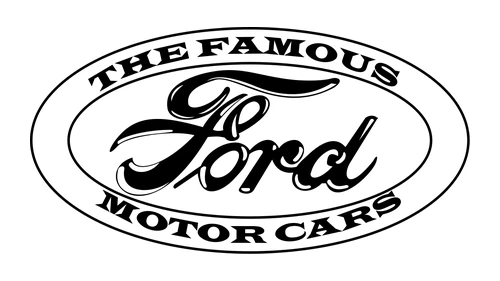
1911: “The Famous Ford Motor Cars” double oval
In 1911 the script itself went inside an oval. A black-and-white double ring carried “The Famous” along the top and “Motor Cars” along the bottom, with the Ford script in the center, so the whole badge read “The Famous Ford Motor Cars”. It had no color.
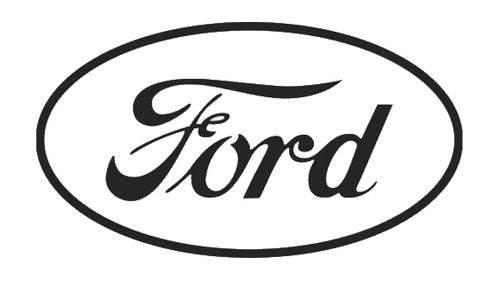
Around 1912: the script in a plain oval
Around the 1910s Ford also printed its script inside a simple oval outline: black letters on white, in one thick black ring, with no other text. Wikipedia’s logo gallery dates it to 1912, while logo sites place it in 1917–1927, so the exact years are uncertain. Its layout is the direct ancestor of the Blue Oval.
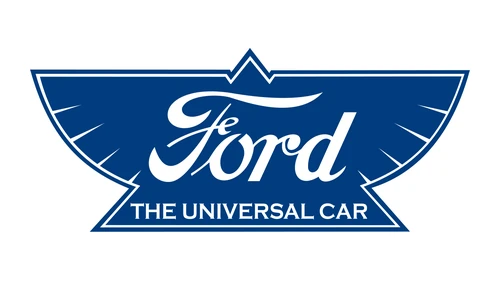
1912: “The Universal Car” winged badge
In 1912 Ford tried a winged triangle with the script in the middle and “The Universal Car” beneath it. The wings were meant to suggest speed, lightness, grace and stability. It came in orange or dark blue, so this was the first Ford mark in blue. Henry Ford disliked it, and it was soon dropped.
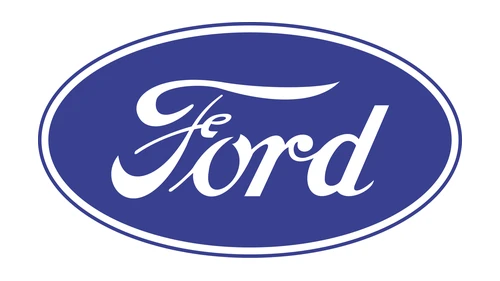
1927–1957: the first Blue Oval on the Model A
The Ford car logo as drivers know it dates from the Model A, launched at the end of 1927 as a 1928 model. It was the first Ford with the oval as a radiator badge: a white or silver script on a royal-blue ellipse with a thin rim. From the 1930s the oval gradually left the grilles and hoods, but it stayed the corporate mark until 1957.
1949–late 1960s: the red, white and blue crest
For about two decades the cars wore a crest instead of the oval. From the 1949 models to the late 1960s, a red, white and blue coat of arms took the oval’s place on Ford vehicles. Ford dates the crest to the 1950s through the late 1960s, and the 1949 start comes from Logopedia.
1957: a redrawn navy oval
In 1957 the corporate oval was redrawn as a true ellipse in deep navy with bolder white letters. A white band, a thin blue line and a thin white outer line formed the rim. Logopedia says it was used internally from August 1957 and first appeared in advertising in 1964. Despite some logo sites, it was not a lozenge.
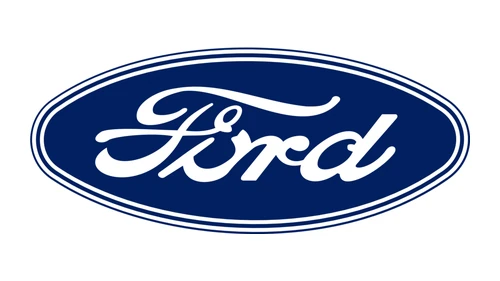
Mid-1960s–1976: the flat corporate oval
In the mid-1960s Ford standardized the oval as the centerpiece of a corporate identity program developed with Unimark International. The mark was flat: a navy oval, a white script and a single white line inside the edge, with no gradient or chrome. It looks almost the same as today’s flat logo. Paul Rand’s 1966 alternative was never adopted.
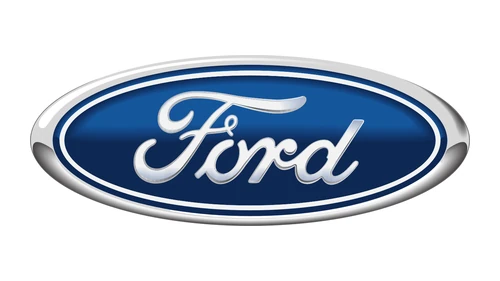
1976–2003: the blue-and-silver Ford badge
This is the Ford car logo most people picture: a glossy blue oval with a silver script and a double chrome rim. It became the identification badge on Ford vehicles, plants and products. The oval began returning to Ford cars in 1976, and by the early 1980s (1982 for exterior badges in North America, according to Ford) it was back on the whole range.
2003–2017: the Centennial Blue Oval
For its 100th anniversary in 2003, Ford created the Centennial Blue Oval. It kept the 1976 layout but used a brighter blue gradient with a lighter center, a softly shaded white script and a thin light rim in place of the heavy chrome. It was the corporate logo until 2017 and stayed on vehicle badges until the flat badge arrived.
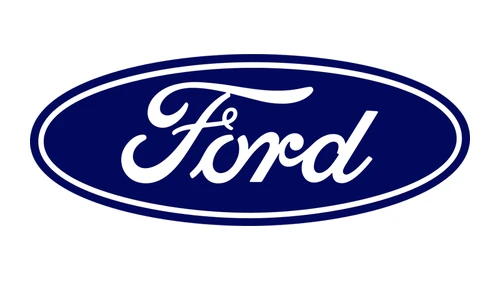
2017–present: the flat Blue Oval
Since 2017 the primary Ford Motor Company logo has been a flat, two-dimensional oval. It is a dark navy oval with a white script and one thin white line inside the edge, without gradient or chrome. The design is close to the mid-1960s corporate oval. This is also the version our Download button provides.
2023: the new Ford logo reaches the cars
The new Ford logo on the cars is the flat oval turned into a physical badge. It debuted on the 2024 F-150, shown in September 2023. The badge drops the chrome, swaps the double rim for a single contour line and uses a larger, flatter script in blue and white only. It spreads to other models as they are renewed.
Ford blue and the Ford script font
The blue of the Ford logo has never been one fixed shade. It has shifted from the dark blue of 1912 to royal blue in 1927, deep navy in 1957, metallic gradients in 1976 and 2003, and flat dark navy since 2017. Ford’s heritage pages give the color no official meaning.
| Version | Blue | Finish |
|---|---|---|
| 1912 winged badge | Dark blue (or orange) | Flat print |
| 1927 Model A oval | Royal blue | Radiator badge with a thin rim |
| 1957 and mid-1960s ovals | Deep navy | Flat |
| 1976 badge | Darker blue with a gradient | Glossy, chrome rim |
| 2003 Centennial | Brighter blue gradient, lighter center | Dimensional, thin light rim |
| 2017 flat logo and 2023 badge | Dark navy | Flat, no chrome |
Ford’s heritage history gives no color codes, so treat any HEX or RGB value you find for Ford blue as an approximation of the flat navy, not an official figure.
The Ford script is not a font. It is custom lettering, a flowing, Spencerian-style pen script. You can’t type it, but look-alike typefaces such as FordScript, Neville and Fabiola Script come close. For any real use, work from the logo artwork rather than a font imitation.
The Ford logo Mandela effect: did the F always have a curl?
Yes. The curl on the F has been part of the Ford script since the end of 1910, when the lettering took its modern form, and it sits inside every oval Ford has used since. No oval has ever carried an old Ford logo script without it.
The idea that the F once had no curl circulates online as a “Mandela effect”, the label for a shared false memory. The badges settle it. Before 1910 the script with wings had a long-tailed F. When Ford revised the lettering at the end of 1910, the crossbar of the F became the small curl that is still there, and the 1927 radiator oval, the 1976 chrome badge and the 2017 flat logo all carry it.
Why the Mustang doesn’t wear the Ford logo
The Mustang wears a galloping pony instead of the Blue Oval because the pony is a model emblem, not a version of the Ford logo. Drawn by Phil Clark, it dates from 1964 and marks the car line, while the oval remains the maker’s mark on the rest of the range.
The Mustang was introduced on April 17, 1964, at the New York World’s Fair, with the pony as its emblem from the start. Our Mustang page covers the Ford Mustang logo and its versions in detail, and the Shelby Mustang page covers the Shelby cars.
- Mustang: galloping pony, since 1964.
- F-150 Raptor: large FORD block letters on the grille instead of the oval, according to most descriptions of the truck.
- Lincoln: Lincoln, Ford’s luxury brand, is generally described as using its own star emblem rather than the oval.
Ford logo PNG, transparent and black-and-white versions
The Download button above gives you a Ford logo PNG of the current flat Blue Oval on a transparent background. It is the 2017 corporate version: navy oval, white script and a single thin white line inside the edge, with no gradient.
Other forms you may need:
- Ford logo transparent PNG (flat corporate oval, 2017): the current standard, and the one in our file.
- Centennial gradient (2003): the glossy version that stayed on cars until the flat badge arrived.
- The Ford logo in black and white: a one-color rendering of the oval, handy for print and engraving.
- Outline: the oval and script as line art only.
What car brands does Ford own?
Ford owns two car brands today: Ford and Lincoln, its luxury brand, bought in 1922. It also owns the Motorcraft brand. Over the years Ford also owned Mercury, Jaguar, Land Rover, Volvo and Aston Martin, and held a stake in Mazda, but it has sold or closed all of them.
| Brand | Ford ownership | What happened |
|---|---|---|
| Lincoln | Since 1922 | Still Ford’s luxury brand |
| Motorcraft | Current | Still a Ford brand |
| Mercury | Set up in 1938, launched for 1939, until 2011 | Closed in 2011 |
| Jaguar | 1989–2008 | Sold to Tata on June 2, 2008, together with Land Rover, for $2.3 billion |
| Land Rover | 2000–2008 | Sold to Tata with Jaguar |
| Volvo Cars | 1999–2010 | Sold to Geely |
| Aston Martin | Until 2007 | Sold to a consortium |
| Mazda | Stake, 1974–2015 | Shares sold |
One more brand has a Ford link, though not an ownership one. Cadillac grew out of the Henry Ford Company of 1901, which became Cadillac in 1902 after Henry Ford left it. Cadillac is not a Ford brand; Henry Ford went on to found Ford Motor Company in Detroit in 1903. For other American makers, see our list of American car brands.
Frequently asked questions
Why did Ford change its logo?
Ford has refined its logo rather than replaced it. The 2023 change brought the car badge in line with the flat corporate oval Ford has used since 2017, dropping the chrome and the double rim. Ford senior designer Rob Brancheau confirmed the update to Car and Driver, and it reaches each model as that model is renewed.
What is the official Ford logo?
The official Ford Motor logo is the Blue Oval: the Ford script in white on a navy oval. The flat, two-dimensional version has been the primary corporate logo since 2017, and new models get a matching flat badge, first seen on the 2024 F-150. "Blue Oval" is also a common nickname for the company itself.
Is the Ford logo copyrighted?
The Ford logo is protected mainly as a trademark rather than by copyright. Ford registered its script with the U.S. Patent Office in 1909, and today both the oval and the script are registered trademarks that Ford licenses for merchandise and accessories. Putting the logo on products you sell generally needs Ford's permission. This is not legal advice.
What was Ford called in 1908?
In 1908 the company was already called Ford Motor Company, the name it has carried since it was incorporated in Detroit on June 16, 1903. That was also the year it introduced the Model T. Henry Ford's earlier venture, the Henry Ford Company of 1901, was a separate business. Ford Motor Company is sometimes shortened to FoMoCo.
What is Ford's slogan?
Ford's current global tagline is reported to be "Ready, Set, Ford", a campaign by the agency Wieden+Kennedy launched in September 2025. Ford has used many slogans over the decades. In the 1980s, for example, its advertising asked "Have you driven a Ford, lately?" Check ford.com for the line Ford is using right now.
Where can I buy a genuine Ford emblem?
For a current Ford emblem or badge, start with the parts counter at a Ford dealer. Ford licenses its oval and script, and its official merchandise store groups the designs as "Ford Oval", "Ford Script" and "Vintage Ford". For older cars, look for officially licensed reproduction Ford emblems.
Who founded Ford, and who was its first president?
Henry Ford founded Ford Motor Company in 1903, at age 39, backed by twelve investors who put up $28,000 in cash; the best known were the Dodge brothers, John and Horace. He was not its first president, though. That was the banker John S. Gray. Early cars were built on Mack Avenue, then Piquette Avenue, in Detroit.
Who owns Ford Motor Company today?
Ford is a public company traded on the New York Stock Exchange under the ticker F. The Ford family still holds only about 2% of the equity but 40% of the voting power through its Class B shares. William Clay Ford Jr. is executive chairman, and Jim Farley has been president and CEO since August 2020.