Key facts
- Founded
- 1964
- Founded by
- Ford Motor Company (developed under Lee Iacocca)
- Country
- United States
- Headquarters
- Dearborn, Michigan, United States
- Parent company
- Ford Motor Company
- Famous models
- GT, Mach 1, Boss 302, Bullitt, Dark Horse, Shelby GT500, Mustang Mach-E (electric crossover)
- Website
- www.ford.com/cars/mustang
What the Mustang logo means
The Mustang logo is a wild horse galloping to the left, the same animal the car is named after. A mustang is a free-roaming horse of the American West, and the Mustang horse logo was picked to suggest that freedom and open space, not speed on a racetrack.
Lee Iacocca, the Ford Division general manager who championed the car, summed it up: “The Mustang is a wild horse, not a domesticated racer.”
The horse exists because of the name, which has several claimed authors, including Ford stylist John Najjar, a fan of the P-51 Mustang fighter, and market researcher Robert Eggert. Ford’s ad agency, J. Walter Thompson, put it on the shortlist, and it beat Cougar, Torino, Allegro and T-Bird II in consumer tests.
The Mustang also gave its name to the whole pony car class, so the Mustang horse logo car fans see on the grille is usually just called “the pony.” It is one of several car logos with horses, but the Mustang symbol has no link to the rearing horse of Ferrari.
Who designed the Mustang logo
Phil Clark, a Ford stylist, drew the running horse of the Mustang logo in 1962. A former General Motors designer, he joined Ford in late April 1962, and his horse was chosen that summer as the badge for the Mustang I concept, which he had co-designed with John Najjar. He had been sketching horse badges for years before that. Clark died in 1968, aged 32.
Two modelers made the drawing three-dimensional. Charles Keresztes turned the sketch into a 3-D badge, and a resin cast of it, dated to around 1963, is in the collection of The Henry Ford museum. Keresztes and Waino Kangas then carved the final version in wood around 1963.
The corral, the rectangular frame around the grille pony, came from a different badge. Gale Halderman had drawn a cougar inside a corral for the Cougar, a rival proposal whose cat later became a Mercury emblem. Iacocca signed off on the design, but the pony itself is Clark’s work.
Why the pony runs left
The Mustang horse logo gallops toward the viewer’s left, and sources give different reasons. The most common reading is a nod to the westward pioneering spirit, and some add the counter-clockwise direction of American racing. Motor Trend’s account is more practical: the design team tried the profile horse facing left, then Iacocca and Halderman settled on a running, left-facing pony, which is how Clark had always drawn it. The one early exception is the gas-cap pony of 1964½ cars, which runs right.
Which is the real Mustang logo? Horse, tri-bar, snake and Blue Oval
The running horse is the real Mustang logo. The other emblems you see on some Mustangs belong to a trim, a performance model or Ford itself. Shelby, SVT and Dark Horse models carry their own badges beside the Mustang logo, and Ford’s Blue Oval sat on the grille only in certain years.
| Emblem | What it is | Where you see it | What it belongs to |
|---|---|---|---|
| Running pony | A horse galloping left, drawn by Phil Clark in 1962 | Grille, fenders and gas cap of the first cars; still on today’s Mustang and the Mach-E | The Mustang itself |
| Tri-bar | Vertical red, white and blue bars behind the pony | Fender badges of 1960s cars; the 2012 Boss 302 grille | Part of the Mustang badge |
| Cobra snake | A coiled Cobra, Carroll Shelby’s emblem | Shelby GT350 and GT500, the Ford SVT Mustang Cobra | Shelby and Ford’s SVT models |
| Blue Oval | Ford’s corporate logo | Mustang grilles from 1983, in the Fox Body era | Ford Motor Company |
| Horse head | A front-facing horse head in black and gray | Fenders of the Dark Horse, from the 2024 model year | The Dark Horse trim |
Ford Mustang logo history: every version since 1962
The horse has stayed a running pony since 1962, but the Ford Mustang logo had three major redraws, for the 1974, 1994 and 2010 model years. It was mostly missing from the grille in the Fox Body years, when Ford’s Blue Oval arrived there.
1962: Clark’s sketch and the Mustang I concept badge
Clark’s first sketch showed the horse angled toward the viewer, with red, white and blue bars behind it. It never went on a car in that form. For the Mustang I, a two-seat, mid-engine concept built by Troutman & Barnes, the horse was turned into full profile. The car debuted at the US Grand Prix at Watkins Glen on October 7, 1962. It was the first car to carry the Mustang name, but it was not an ancestor of the production model, and its pony was too tall for a production grille.
Around 1963: the wooden model
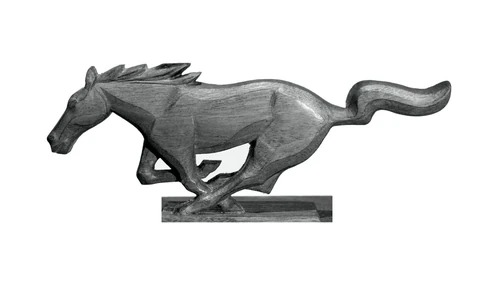
Keresztes and Kangas reworked those proportions and carved the pony in wood. The model shows a running, left-facing horse with hard, sculptural edges that later badges softened. It stayed a reference point: the 2010 pony was redrawn to look closer to this carving.
1963: the Mustang II concept and the first corral
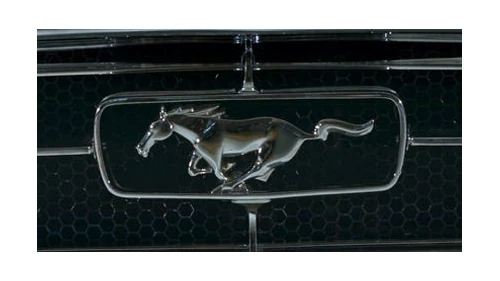
The Mustang II concept of October 1963, a four-seater and a much closer preview of the production car, gave the pony its corral. Its smoothed, chromed horse ran inside a rectangular frame with its tail flowing back. Like the Mustang I, it was shown at Watkins Glen. It is not the 1974 production Mustang II: the two share a name, but not a badge.
1964½–1973: the original production pony and the tri-bar
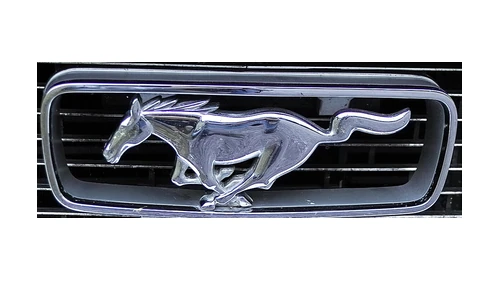
The production Mustang, wearing the pony, debuted on April 17, 1964, at Ford’s pavilion at the New York World’s Fair, where Henry Ford II unveiled it. These first cars are known as 1964½ models, although all were titled as 1965s. This is the old Mustang logo most people picture. A chrome pony ran inside the grille corral, a flatter pony sat in front of the red, white and blue bars on the fenders, and the gas-cap pony ran right across the bars. There was no Ford Blue Oval on the car.
1974–1978: Mustang II, the first redrawn pony
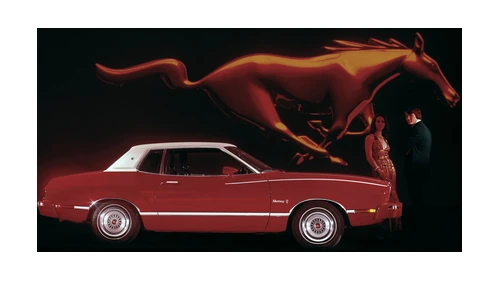
The Mustang II, introduced on September 21, 1973, brought the first major redraw. The horse got a larger, blockier and more upright head, with its tail streaming back, and it looks less muscular, closer to a canter than a gallop. On the fender badge, a Roman numeral II took the place of the tricolor bars. On the grille, the pony left its corral and roamed free on the egg-crate texture.
1979–1993: Fox Body, when the pony left the grille
Fox Body Mustangs mostly went without the Mustang logo on the grille. For a few years, a round tricolor pony emblem sat on the hood instead. From 1983, the grille carried Ford’s Blue Oval, the first time the Ford corporate logo appeared on the front of a Mustang.
1994–2004: SN-95 and the return of the pony
The SN-95 Mustang debuted in November 1993 as a 1994 model, with styling by Patrick Schiavone. Its pony ran free without the corral, with the smaller head and kinked tail of the 1960s original. Sources disagree on where the main pony sat on some models, the grille or the fenders, so check photos of the exact car if you need a matching badge.
2005–present: the Pony Package corral and the 2010 pony
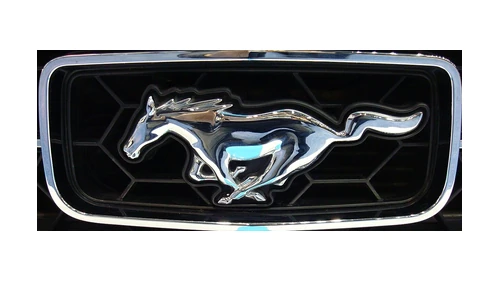
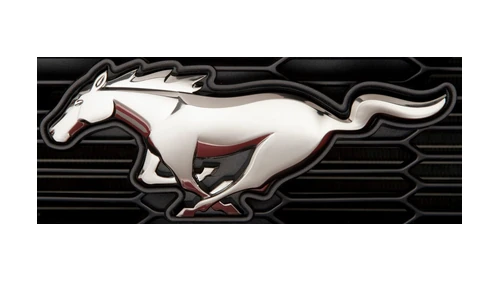
The corral came back on special models such as the Pony Package, offered on fifth- and sixth-generation cars from 2005 to 2018. The bigger change came with the 2010 model year, released in spring 2009. The pony was redrawn with harder edges, crisper lines and a more stylized, spiky mane. On the 2012 Boss 302, it sat on top of the tricolor bars.
The 2010 pony is still the new Mustang logo on today’s cars. It continues on the seventh-generation Mustang launched for 2024, where the Dark Horse trim adds its own front-facing horse head on the fenders.
2019–present: the Mustang Mach-E badge
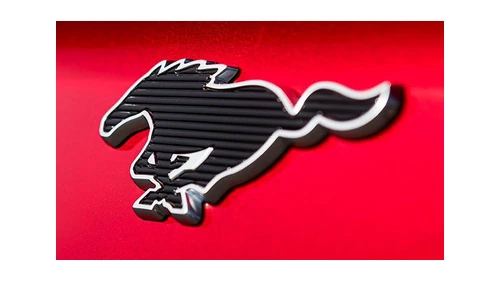
The Mustang Mach-E, an electric crossover announced on November 17, 2019, shares the Mustang name and logo. Its pony is a metal-framed silhouette with a striped fill that recalls the tri-bar. The Mach-E is a separate model, not one of the seven Mustang generations, so if you see the Mustang car logo on a crossover, this is the car.
Why is there no Ford logo on a Mustang?
The Mustang logo, the running horse, has been the car’s own emblem since the 1962 concept car, and the first production cars of 1964 had no Blue Oval at all. The pony sat on the grille, the fenders and the gas cap.
The car is still a Ford: an American model and the company’s longest continuously produced nameplate, built in Dearborn from March 9, 1964. On the car itself, though, the name and the horse do the branding.
The Fox Body era is the exception. From 1983, when the pony had mostly left the front of the car, Mustang grilles carried the Blue Oval. The 1994 redesign brought the running pony back as the main emblem. For the oval’s own history, see the Ford logo page.
Mustang snake logo: the Cobra badge on Shelby cars
The Mustang snake logo is the Cobra, Carroll Shelby’s coiled-snake emblem, not the Mustang logo. The Mustang with the snake logo is a Shelby, such as a GT350 or GT500, or a Ford SVT Mustang Cobra. On those cars the snake rides beside the running pony. It never replaced it.
Shelby Mustangs share the Cobra emblem with the AC and Shelby Cobra sports car, and it appears on them from the 1965 GT350 era. For 1968, the Cobra name was formally added to the GT350 and GT500.
Ford later used the snake on its own. The SVT Cobra was built by Ford’s Special Vehicle Team, not by Shelby American. The 2007–2014 Shelby GT500 was also a Ford-built car with Shelby branding, and the GT500 returned for 2020. Super Snake is a Shelby high-performance package name that goes back to a 1967 GT500 prototype with a 427 engine.
| Model | Years | Who is behind it | Badge |
|---|---|---|---|
| Shelby GT350 | From 1965 | Carroll Shelby | Cobra snake |
| Shelby GT500 | From 1967 | Carroll Shelby | Cobra snake |
| Ford SVT Mustang Cobra | 1993–2004 | Ford’s Special Vehicle Team | Cobra snake |
| Shelby GT500 (Ford-built) | 2007–2014, then from 2020 | Ford, with Shelby branding | Cobra snake |
| Super Snake | Name dates to a 1967 prototype | Shelby | Shelby package name |
| Mustang, Mustang GT, Mach-E | From 1964 (Mach-E from 2019) | Ford | Running pony |
For current Shelby models and the Shelby emblem itself, see the Shelby Mustang page.
Mustang badges and emblems by trim: GT, 5.0, Mach 1, Boss, Dark Horse
The pony tells you the car is a Mustang, and the trim badge tells you which one. The Mustang GT logo is the GT lettering of the V8 performance trim. On recent GTs, a 5.0 badge on the front fender usually gives it away, since it names the engine.
| Mustang badge | What it means | Worth knowing |
|---|---|---|
| GT | The V8 performance trim, generally read as short for Grand Touring (Gran Turismo in Italian) | The GT returned in 1982, replacing the Cobra |
| 5.0 | The engine’s 5.0 liters of displacement | Per Motor Authority, it came back with the 5.0 L Coyote V8 on the 2011 GT, which replaced the 4.6 L V8 |
| Mach 1 | A performance trim | The 2024 Dark Horse was positioned above it |
| Boss 302 | A performance model | The 2012 car put the 2010 pony on top of the tri-bars in its grille |
| Bullitt | A nameplate that refers to Steve McQueen’s 1968 film Bullitt | The film helped make the Mustang a pop-culture star |
| Cobra | The coiled snake | Ford SVT’s Mustang Cobra, 1993–2004 |
| GT350, GT500 | Shelby models | They carry the Cobra snake emblem |
| Dark Horse | The 2024 trim with a 500 hp 5.0 L V8, between the Mach 1 and the discontinued GT350 | Its fender emblem is a front-facing horse head in black and gray |
Every Mustang emblem in this table sits alongside the pony, not in place of it. For other American performance cars, see our list of muscle car brands.
Mustang logo PNG and other logo files
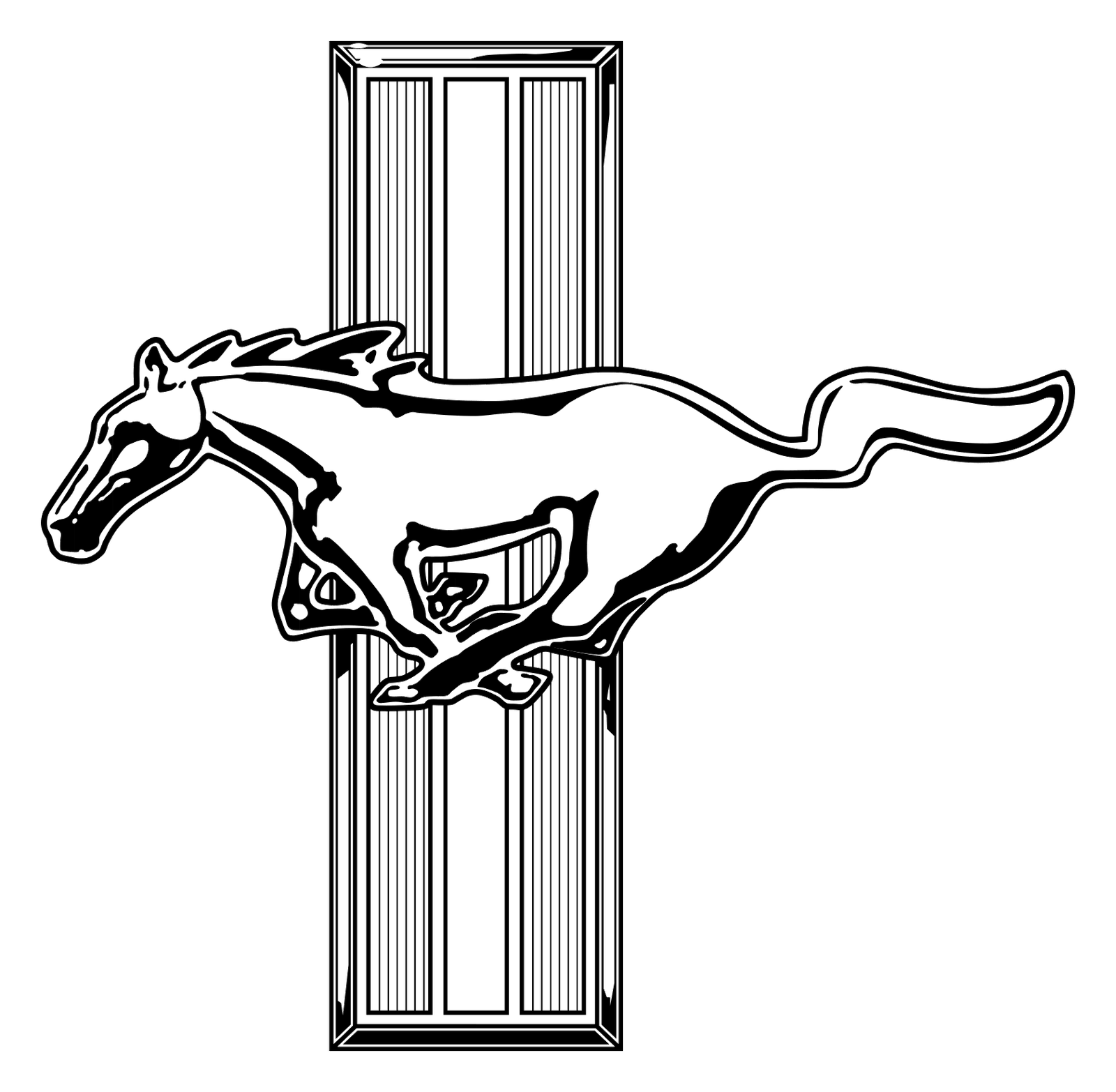
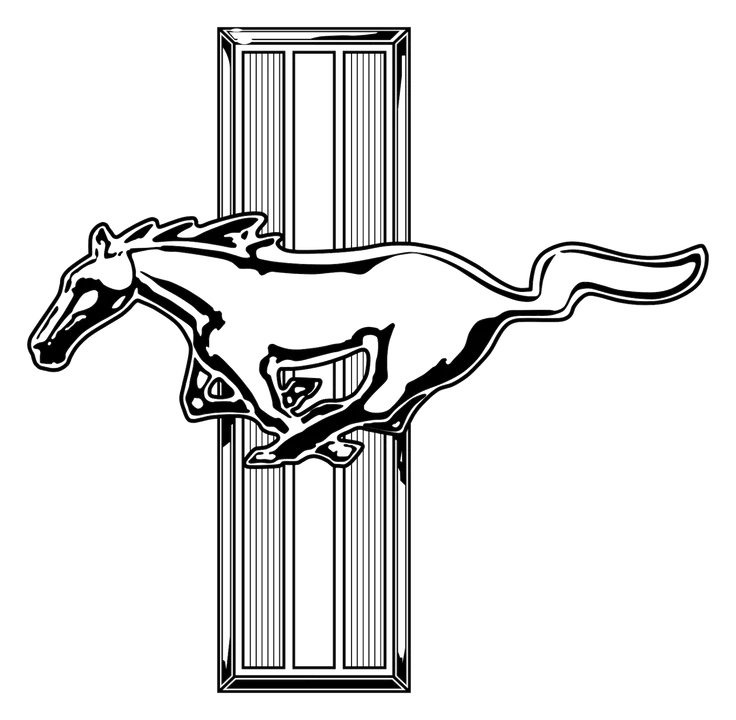
The Mustang logo PNG behind the Download button above is black-and-white line art of the 1960s pony running in front of the tri-bar, the Mustang logo car owners know from early fender badges. It is 1600 × 1566 pixels with a transparent background, so it works whenever you need the Mustang logo in black and white. The real badges were chrome, with red, white and blue bars on the fenders, so recolor the file for a color match. Use it for reference and editorial work; for merchandise or anything you plan to sell, check Ford’s licensing rules first.
Frequently asked questions
Why does Mustang have two logos?
A Mustang has one logo, the running pony. A second badge on the car belongs to a specific model: the Cobra snake marks Shelby Mustangs and Ford SVT's Mustang Cobra, and the Dark Horse wears a front-facing horse head on its fenders. If you only see the pony, you are looking at a regular Mustang.
Is the Ford Mustang logo a horse or a snake?
It is a horse. The Ford Mustang logo, the Mustang symbol since Phil Clark drew it in 1962, is a wild mustang galloping left. The snake is the Cobra, Carroll Shelby's emblem, found only on certain models such as Shelby GT350s and GT500s. A car with a snake badge is still a Mustang, just a special one.
Why does the Ford Mustang have a Ferrari logo?
It doesn't. The Ford Mustang logo is a horse galloping to the left, while Ferrari's prancing horse rears on its hind legs, in black on a yellow background. Ferrari's horse came from World War I pilot Francesco Baracca. Enzo Ferrari adopted it after meeting Baracca's mother in 1923, and his team first used it in 1932.
Is Mustang Cobra a Shelby?
Not always. Shelby's cars carry the Cobra snake, but the Mustang SVT Cobra of 1993 to 2004 was a Ford product, developed in-house by the company's SVT division rather than by Shelby American. It was announced at the 1992 Chicago Auto Show, and 79,958 were built. Shelby models, such as the GT350 and GT500, are a separate line.
Why did Mustang change its logo?
Each major redraw of the pony arrived with a new or refreshed car: the Mustang II for 1974, the SN-95 for 1994 and the 2010 update. The horse itself was never replaced, and the name has stayed in continuous production since 1964, longer than any other Ford nameplate.
What car has a Mustang logo?
The Mustang car logo is on the Ford Mustang sports car and on the Mustang Mach-E, Ford's electric crossover. Shelby versions wear the pony alongside their snake. The current, seventh-generation Mustang has been built at Flat Rock, Michigan, since May 2023, while the Mach-E counts as a separate model rather than a Mustang generation.
Is Mustang American or German?
The Mustang is American. Ford has built it since 1964, starting in Dearborn, Michigan. The German link is its name: Krupp owned the Mustang name in Germany, so Ford sold the car there as the T-5 until December 1978, with T-5 badges next to the pony. T-5 was also the project's internal code name at Ford.
Did Lee Iacocca invent the Mustang?
Not on his own. Lee Iacocca, then general manager of the Ford Division, championed the project and made key calls, including the left-facing pony, which he chose with designer Gale Halderman. Donald N. Frey was the project's head engineer, and stylist Phil Clark drew the pony badge. The name itself has several claimed authors.
Where can I buy a Mustang emblem?
Ford dealer parts counters and aftermarket parts shops both sell Mustang emblems, from grille ponies to fender badges. Check the model year first. The pony was redrawn for 1974, 1994 and 2010, so the Mustang horse logo car owners need depends on the year, and trims such as the GT, Dark Horse or Shelby models use different badges.