Key facts
- Years active
- 1911–1995
- Founded by
- Harry C. Stutz, Henry F. Campbell
- Country
- United States
- Headquarters
- Indianapolis, Indiana, United States
- Legal name
- Stutz Motor Car Company
- Famous models
- Bearcat, Blackhawk, Vertical Eight, DV-32
- Slogan
- “The Car That Made Good in a Day”
Brand Overview
Stutz began as the Ideal Motor Car Company in 1911. The company was founded in Indianapolis by Harry C. Stutz and Henry F. Campbell. In June 1913 the Ideal Motor Car Company changed its name to Stutz Motor Car Company after merging with Stutz Auto Parts Company.
The headquarters remained in Indianapolis throughout its primary operational period from 1911 to 1939. Automobile production effectively ceased in 1935 due to financial difficulties and the company was declared defunct in 1939. The brand was revived in 1968 as Stutz Motor Car of America and introduced new neoclassic models in 1970 before factory vehicle production ended in 1995.
Brand Timeline
The Stutz brand followed a clear sequence of key events. It was founded in 1911 as Ideal Motor Car Company in Indianapolis. The official name change to Stutz Motor Car Company occurred in 1913 along with the merger of Stutz Auto Parts Company.
Harry C. Stutz left the company in 1919. During the 1920s the brand shifted toward luxury cars for the rich and famous while developing safety-focused vehicles. Primary automobile production ended in 1935 and the company was declared defunct in 1939 following bankruptcy proceedings.
The brand experienced a revival in 1968 as Stutz Motor Car of America. New neoclassic models including the Blackhawk debuted in 1970. The company continued as a dormant marque after factory production ended in 1995.
Stutz Logo Evolution
1911–1935: Original Roundel Logo

The first Stutz logo was used throughout the company’s founding era name change and primary manufacturing period. This roundel design served as the Stutz car logo during the peak years of sports and luxury car production. The emblem maintained consistent visual identity from the original Ideal Motor Car Company through the renamed Stutz Motor Car Company until production ceased in 1935.
- Design: Roundel circular badge shape with wide white border framing a dark red center
- Colors: Dark red central field white border glossy gold lettering and blue winged emblem
- Changes: Blue winged emblem overlapping the roundel with white stylized brand name Stutz on the wings
- Context: Represented the company from its 1911 founding through the 1913 renaming and up to 1935
The original Stutz emblem provides clear insight into early automotive branding approaches that emphasized bold circular shapes and contrasting colors for visibility.
1971–1995: Revival Minimalist Roundel
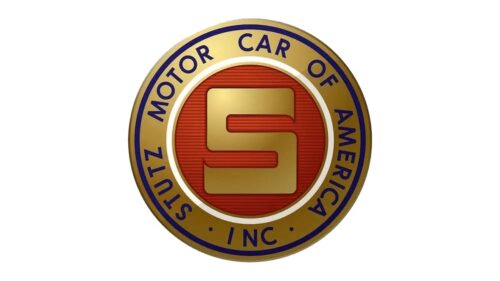
The second Stutz logo was created for the 1968 brand revival and entered use in 1971. This design coincided with the launch of new neoclassic models under Stutz Motor Car of America. The updated Stutz symbol preserved the circular roundel format while adopting a more minimalist approach suitable for the luxury positioning of the revival era.
- Design: Circular round badge with outer perimeter text surrounding a central red field
- Colors: Gold as the dominant shade with red central field and blue lettering
- Changes: Large golden letter S in the center with full company name in blue sans-serif capitals around the edge
- Context: Used during the production of neoclassic luxury vehicles from 1971 until 1995
This later Stutz badge maintained visual continuity with the original roundel concept despite the 36-year gap between active periods. The evolution from the first to the second logo reflects changing luxury aesthetics while keeping the core circular identity intact. The Stutz logo history demonstrates how the brand preserved its heritage through consistent shape choices across both eras.
Fans of automotive branding often seek high quality references including Stutz logo png files with Stutz logo transparent background for research and design projects. The distinct roundel formats from both periods offer excellent examples of Stutz logo evolution through the decades.