Key facts
- Founded
- 1904
- Founded by
- Damián Mateu, Marc Birkigt
- Country
- Spain
- Headquarters
- Barcelona, Spain
- Parent company
- Grupo Peralada
- Famous models
- H6, K6, J12, Carmen
- Website
- hispanosuizacars.com
Brand History
Hispano-Suiza was founded in 1904 in Barcelona by Damián Mateu and Swiss engineer Marc Birkigt as La Hispano-Suiza Fábrica de Automóviles. The company quickly expanded by establishing a French factory between 1911 and 1914 in Levallois-Perret then Bois-Colombes, making France its primary market for luxury cars.
During World War I the firm shifted to aircraft engine production and developed the iconic Hispano-Suiza 8 V8 engine. It returned to automobile production in 1919 with the advanced H6 model and introduced the stork hood ornament. The French arm became semi-autonomous in 1923 as Société Française Hispano-Suiza while the Spanish parent retained majority control.
French car production ceased in 1938 at government request as the company focused on aero engines. Spanish Civil War and postwar events led to factories being collectivized and later sold to ENASA in 1946. The French aviation division was acquired by Snecma in 1968. The founding Suqué Mateu family officially revived the brand in 2019 under Grup Peralada with the fully electric Carmen hypercar.
Hispano-Suiza Logo Evolution
1904–1907: Founding Era Logo

- Design: Black-and-white elegant frame with “La Hispano-Suiza” in uppercase letters across two lines
- Colors: Black and white
- Changes: Curved top line with “Barcelona” in smaller font at bottom
- Context: Introduced when the company was founded in Barcelona by Damián Mateu and Marc Birkigt
1907–1914: Early Sophistication

- Design: Delicate graceful cursive font with flying stork symbol
- Colors: Black
- Changes: Added stork motif and tagline “Fabrica de Automoviles S.A.” at bottom
- Context: Hispano-Suiza logo meaning began to incorporate the stork as a symbol of a bright future
1914–1936: Winged Symbol Period
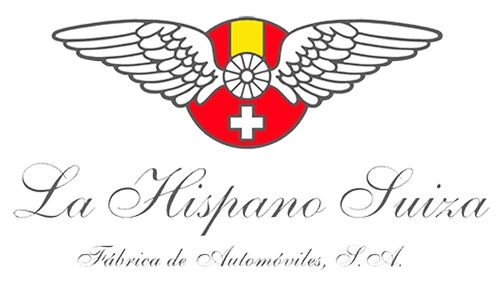
- Design: Two white widespread wings over a red circle
- Colors: Red, white, yellow
- Changes: Replaced earlier text-focused design with prominent winged symbol
- Context: Used during peak luxury production and Hispano-Suiza logo history tied to WWI aviation
1917–1936: Three-Dimensional Emblem
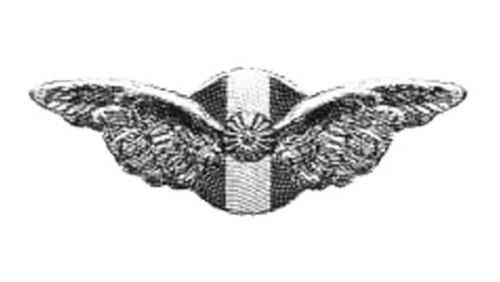
- Design: 3D winged symbol on round bubble-textured base with flower-like center
- Colors: Black, white, yellow
- Changes: Added yellow line extending downward and conservative styling
- Context: Represented the brand during and after World War I
The Post-WWI mascot introduced in 1919 became an important Hispano-Suiza car symbol. A flying stork hood ornament designed by sculptor François-Victor Bazin paid tribute to French ace Georges Guynemer and the “escadrille de Cigognes” that used Hispano-Suiza engines. This stork emblem directly linked WWI aviation success to automobile branding and has remained part of the Hispano-Suiza logo evolution ever since.
2010–2019: Modern Revival Attempt

- Design: Abstract triangular shape based on 1914 winged logo
- Colors: Dark gray
- Changes: Wings made more abstract with bold geometric sans-serif font
- Context: Represented a preliminary effort before the official brand revival
2019–2021: Digital Heritage Refresh

- Design: Sharper more dynamic wings with restored round red shape
- Colors: Gray gradient with red
- Changes: Returned to graceful cursive font while modernizing wings
- Context: Created for the electric era revival by the Suqué Mateu family
2021–Present: Current Logo
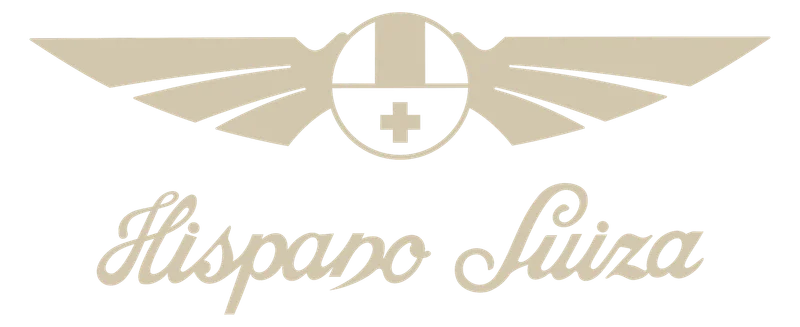
- Design: Same shape and inscription as 2019 version with metallic wings
- Colors: Muted light gray, softer red and yellow
- Changes: Removed gradient for cleaner metallic appearance
- Context: Current Hispano-Suiza logo used by the revived brand focusing on electric vehicles
Legacy and Impact
The Hispano-Suiza logo history shows a consistent thread of the stork and winged symbol that originated from wartime aviation success. Each redesign has preserved core elements while adapting to new eras from the 1904 founding through the 2019 revival. Today the Hispano-Suiza symbol continues to represent luxury engineering and heritage under the original family’s guidance.