Key facts
- Founded
- 1857
- Founded by
- Alexander Wilson
- Country
- United Kingdom
- Headquarters
- Coventry, United Kingdom
- Parent company
- Stellantis
- Legal name
- Vauxhall Motors Limited
- Famous models
- Astra, Corsa, Cavalier, Viva, Victor
- Website
- www.vauxhall.co.uk
Brand Origin and the Vauxhall Symbol
Vauxhall was established in 1857 by Alexander Wilson in the Vauxhall district of London as Vauxhall Iron Works. The name comes from “Fulk’s Hall,” referring to the mansion of Sir Falkes de Breauté, a 13th-century mercenary soldier granted the Manor of Luton. Sir Falkes de Breauté’s ancient coat of arms provided the griffin that became the Vauxhall car logo.
The company produced its first car in 1903. When it relocated to Luton in 1905 the griffin emblem returned to its ancestral home. The mythical creature, featuring an eagle’s head and wings combined with a lion’s body, has symbolized power, majesty and guardianship for the brand since its adoption.
Vauxhall Logo Evolution
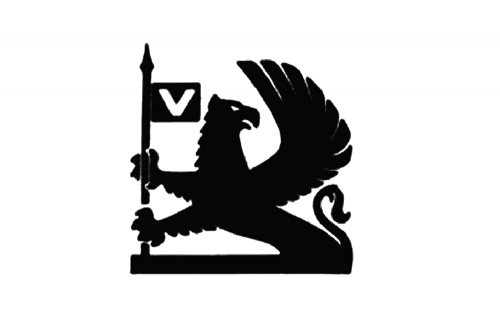
1857–1983: Original Griffin Era
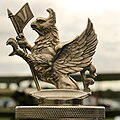
The original Vauxhall emblem featured a classic griffin holding a black flag displaying a bold sans-serif “V”. This design served the company for over 125 years and firmly established the mythological creature as its central symbol.
- Design: Griffin with eagle head and wings plus lion body
- Colors: Monochrome with black flag
- Changes: None for more than a century
- Context: Used from founding through many ownership changes
1983–1989: Colored Square Variant
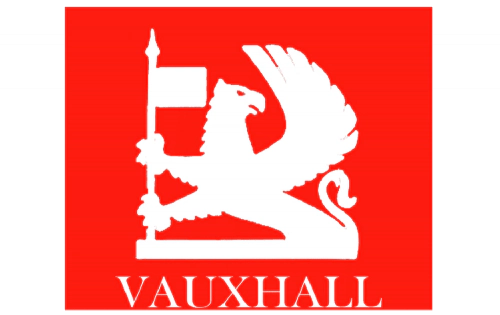
This period marked the first major application of color to the Vauxhall badge. The white griffin appeared inside a red square with a thick outline while the “V” was temporarily removed from the flag.
- Design: White griffin inside square frame
- Colors: Red square with white griffin
- Changes: “V” removed from flag and serif wordmark added
- Context: First modern visual update after 125 years of the original design
1989–2003: Circular Red Badge
The Vauxhall car symbol returned to a circular format set against a red background during this era. The “V” was restored to the flag and a large black wordmark appeared below the badge.
- Design: Griffin with flag inside circle
- Colors: Red circle with white griffin and black text
- Changes: Reintroduction of the letter “V” on the flag
- Context: Brought back elements from earlier designs
2003–2008: Three-Dimensional Silver
A metallic look defined this phase of the Vauxhall logo evolution. The griffin appeared in gradient silver while the wordmark was removed entirely.
- Design: Three-dimensional metallic griffin
- Colors: Silver with no framing
- Changes: Wordmark removed and premium appearance emphasized
- Context: Focused on conveying luxury and power
2008–2013: Enlarged Griffin on Black
This revised badge enlarged the griffin image with wings mostly cropped and switched the background from red to black. A silver frame surrounded the emblem and a wordmark was arched across the top.
- Design: Enlarged griffin with cropped wings
- Colors: Black background with silver frame
- Changes: Wordmark arched over frame
- Context: Paid homage to over 100 years of UK manufacturing heritage
2009–2011: Red Background Variant
A short-lived lighter version of the previous badge briefly returned the red background. This variant featured a thinner outline and omitted the wordmark.
- Design: Same enlarged griffin as 2008 version
- Colors: Red background with thinner outline
- Changes: Lighter and more sophisticated look
- Context: Used for only two years
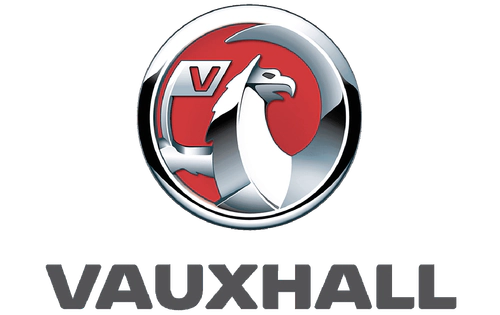
2011–2020: Sharper Monochrome
The Vauxhall emblem received sharper lines and darker gray tones in this period. Additional detail was added to the griffin while a bold sans-serif dark gray wordmark sat below the badge.
- Design: Sharper and more detailed griffin
- Colors: Darker gray tones
- Changes: Enhanced contrast and added lines
- Context: Created stronger visual definition
2020–Present: Simplified Flat Design
The current Vauxhall logo features a minimalist flat design. The griffin is drawn without wings on a red and white circular badge while a dark blue wordmark appears below in a modern sans-serif typeface.
- Design: Simplified flat griffin without wings
- Colors: Red, white and dark blue
- Changes: Minimalist approach with enlarged flag
- Context: Introduced in 2019 to convey power, passion and trustworthiness
Ownership Changes
Vauxhall experienced two major ownership transitions that influenced its direction. In 1925 General Motors acquired the company for US$2.5 million. The brand was sold by General Motors to PSA Group in 2017, after which the official company name reverted from General Motors UK Limited back to Vauxhall Motors Limited on 18 September 2017. The parent company became Stellantis in 2021.
Headquarters moved from the original London site to Luton, Bedfordshire in 1905. The current headquarters is listed in Coventry, West Midlands.
Vauxhall Logo Meaning and Enduring Elements
The Vauxhall badge has maintained the griffin as its core symbol continuously since 1857. This mythical creature combines the eagle as king of the birds with the lion as king of beasts, representing strength and vigilance. A flag bearing the letter “V” has remained a consistent feature across nearly all eras.
The Vauxhall emblem has primarily used a red and white color scheme throughout its history, with red representing power, passion and courage. The current design adds dark blue to signify trustworthiness and responsibility. Typography has evolved from early serif wordmarks to the present bold sans-serif typeface.
The Vauxhall logo history reflects both respect for heritage and adaptation to changing design trends. Each update has preserved the griffin while responding to contemporary aesthetics, from ornate Victorian styling through three-dimensional metallic phases to today’s flat minimalist approach.
Users interested in Vauxhall logo png, Vauxhall logo transparent or Vauxhall logo hd versions can find high-resolution assets suitable for reference and personal projects. The complete Vauxhall logo evolution demonstrates remarkable consistency in brand identity over more than 165 years.