Key facts
- Years active
- 1896–1941
- Founded by
- Johann Baptist Winklhofer, Richard Adolf Jaenicke
- Country
- Germany
- Headquarters
- Chemnitz, Germany
- Parent company
- Auto Union
- Legal name
- Wanderer-Werke AG
- Famous models
- W25K, W50, Typ 10, W24
Brand Overview
Wanderer was founded in 1896 in Chemnitz, Germany by Johann Baptist Winklhofer and Richard Adolf Jaenicke. Originally named Chemnitzer Velociped-Depot Winklhofer & Jaenicke, the business adopted the Wanderer brand name in 1911 for both exports and domestic use. The company maintained its primary location in Chemnitz and added a Siegmar plant in 1927.
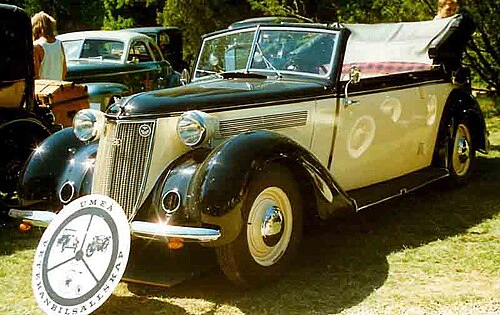
Production of automobiles ran from 1903 until 1945. The brand focused on luxury vehicles and served as a middle and upper-middle class marque within Auto Union after 1932. Civilian car production stopped in 1941 as the factory shifted entirely to military vehicles.
The Siegmar plant was destroyed in 1945, ending the automotive chapter of Wanderer. The brand remains a direct ancestor of Audi through its role as one of the four founding members of Auto Union.
Brand Timeline
Wanderer began as a bicycle manufacturer in 1896. Motorcycle production started in 1902 and automobile manufacturing followed in 1903. The company officially adopted the Wanderer name in 1911.
By 1926 the firm reached high production levels of 25 vehicles per day. A new Siegmar plant opened in 1927 to support continued growth. During the Great Depression from 1929 to 1932 the motorcycle business was sold and the company underwent divestment.
In 1932 Wanderer merged with Audi, DKW, and Horch to create Auto Union AG. From 1932 to 1945 it operated as the middle and upper-middle class brand within the group. All civilian production ceased in 1941 with output switching exclusively to military vehicles until the plant was destroyed in 1945.
The legacy of Wanderer lives on as one of the four rings of Auto Union, directly contributing to the foundation of Audi.
Wanderer Logo Evolution
1896 – 1911: Classic Script Logo

The first logo reflected the company’s early focus on craftsmanship and luxury during its bicycle and initial automobile years.
- Design: Stylized text reading Wanderer in a sophisticated script typeface with interconnected letters
- Colors: Rich gold
- Changes: None during this foundational period
- Context: Represented tradition during the company’s formative phase
1911 – 1920: Double-W Circular Badge
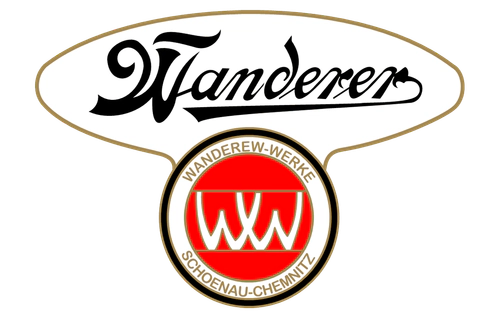
The redesign coincided with the official adoption of the Wanderer name and broader manufacturing expansion.
- Design: Ornate script Wanderer above a central red circular badge featuring a white interlocking double W monogram with location text below
- Colors: Red, white, and gold outline
- Changes: Added monogram, circular badge, and location information
- Context: Strengthened brand identity following the 1911 name change for Wanderer logo history
1920 – 1932: Angular Geometric Double-W

This version marked a clear shift toward modernist design as the company pursued greater automotive ambitions.
- Design: Bold angular double W monogram creating a chevron pattern with sharp symmetrical lines and simple sans-serif Wanderer text underneath
- Colors: Primarily monochrome with emphasis on geometric contrast
- Changes: Moved from ornate script to sharp geometric forms
- Context: Emphasized precision engineering and speed for Wanderer car logo
1928 – 1930: Chequered Racing Shield
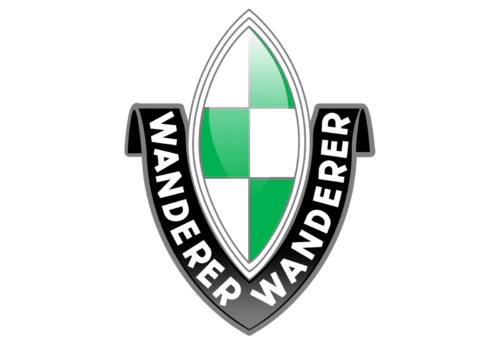
The heraldic approach introduced color and traditional symbolism during a period of motorsport interest.
- Design: Shield with green and white chequered pattern, silver outline, and arched black Wanderer lettering on a silver banner
- Colors: Green, white, black, and silver
- Changes: Adopted heraldic shield form with racing-flag pattern
- Context: Signaled premium positioning and growing performance aspirations
1930 – 1932: Explicit Automotive Chevron

This final independent logo directly tied the brand to its automobile focus just before the merger.
- Design: Large black W monogram creating a chevron with white accents and a curved banner displaying AUTOMOBILE
- Colors: Black and white
- Changes: Added explicit AUTOMOBILE text to the chevron design
- Context: Reinforced speed symbolism in the years leading to the Auto Union merger
1932 – 1945: Integrated Four-Brand Emblem
After the merger the Wanderer emblem became part of the collective Auto Union identity.
- Design: Chevron W retained within the four encircled logos alongside Audi, DKW, and Horch with Wanderer Automobile banner
- Colors: Consistent with prior chevron versions
- Changes: Integrated into the Auto Union quartet while keeping core chevron element
- Context: Maintained distinct identity within the new group structure for the Wanderer symbol
Legacy
Wanderer played a foundational role in German automotive history through its contribution to Auto Union. The brand’s chevron motif symbolized forward motion and precision across multiple logo eras. Its story forms an essential part of Audi’s heritage as one of the original four rings.
Users often seek Wanderer logo png, Wanderer logo hd, and Wanderer logo transparent background files to study this evolution. The progression from script to modernist chevron designs captures the brand’s journey from bicycles to luxury cars. Many also search for Wanderer emblem images and Wanderer badge references when exploring early German automotive branding.
The complete Wanderer logo evolution illustrates how visual identity adapted to changing industrial ambitions and market conditions over five decades. From the early gold script through the final Auto Union integration, each version reflected the company’s position at that moment in time. This documented history provides clear insight into a brand that helped shape the future of Audi.