Key facts
- Years active
- 1904–1940
- Founded by
- August Horch
- Country
- Germany
- Headquarters
- Zwickau, Germany
- Parent company
- Auto Union
- Legal name
- Horch & Cie. Motorwagenwerke AG
- Famous models
- 853, 830, 670, 930V
Horch Brand History
Horch was a pioneering German luxury automobile manufacturer. The company specialized in high-end custom vehicles and became a market leader in the large-car segment during the 1920s. Its story is closely tied to technical innovation and the legacy of its founder, August Horch, who previously worked as an engineer for Karl Benz.
The brand began with roots in 1899 when August Horch established his first company in Cologne. Horch & Cie. Motorwagenwerke AG was officially founded in Zwickau, Saxony, in 1904. The headquarters remained in Zwickau throughout its independent years.
Key Milestones
- 1899: August Horch establishes first company in Cologne
- 1904: Horch & Cie. Motorwagenwerke AG officially founded in Zwickau
- June 1909: August Horch leaves the company after dispute with supervisory board
- 1910: Horch founder establishes new company named Audi in the same city
- 1920s: Horch specializes in expensive custom-made luxury cars
- 1932: Launches successful Model 600 and merges with Audi, DKW, and Wanderer to form Auto Union AG
- 1932–1940: Operates as premium brand within Auto Union
- 1940: Civilian production suspended
- 1940: Horch brand becomes defunct as wartime restrictions end civilian car production
Horch Logo Evolution
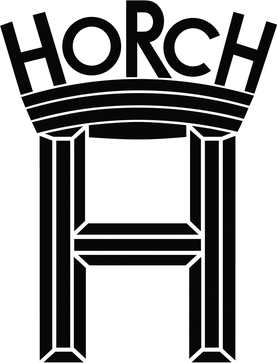
1899–1932: Independent Horch Logo

The standalone Horch logo served the brand from its earliest years until the 1932 merger. This emblem reflected the company’s focus on luxury and engineering precision. Its design captured the elegant mood of the era while communicating premium quality.
- Design: Bold stylized letter H with pattern of thin straight lines creating structure and volume, thick black arch inside the letter with matching white striped pattern, wordmark in all-capital sans-serif typeface placed above the arch
- Colors: Monochrome black and silver palette, silver on cars enclosed in thin circular silver frame with generous white space
- Changes: Letters H, R, and H deliberately enlarged for dynamic appearance
- Context: Used during the independent period when Horch positioned itself as a leader in the luxury car market
This Horch emblem appeared in a geometric sans-serif typeface with variable capital letter heights that created visual rhythm. The closest modern fonts to its style are Heyday Sans or Type Vendor JNL. Silver coloring evoked modernity, sophistication, and premium quality for this Horch logo.
1932–1940: Auto Union Era Logo
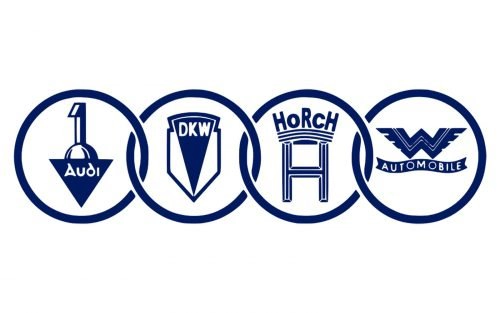
Economic pressures during the Great Depression forced Horch to merge in 1932 with Audi, DKW, and Wanderer. The merger created Auto Union AG and triggered a complete replacement of the standalone Horch logo. The new shared emblem represented all four previously independent manufacturers.
- Design: Four interlinked rings representing Horch, Audi, DKW, and Wanderer, individual brand logos placed inside rings in some variants
- Colors: Blue and white color palette
- Changes: Standalone Horch emblem replaced by collective four-ring symbol
- Context: Horch positioned as the luxury and large-car brand within the new group
The adoption of the four-ring design marked the end of the independent Horch symbol. This change reflected the new corporate structure while maintaining the brand’s premium positioning inside Auto Union until civilian production was suspended in 1940.
Horch Legacy
Horch stands as a direct predecessor of modern Audi. The brand name and its visual heritage live on as one of the four rings in the Audi logo. Its contributions to luxury automobile manufacturing in Germany helped shape the early automotive industry in Saxony.
The Horch car logo from the independent era remains an important example of Art Deco design in automotive branding. Students of logo history and automotive design often reference its clean geometric forms and sophisticated monochrome execution when examining early 20th century luxury emblems.