Key facts
- Founded
- 1909
- Founded by
- Ettore Bugatti
- Country
- France
- Headquarters
- Molsheim, France
- Parent company
- Rimac Group
- Legal name
- Bugatti Automobiles S.A.S.
- Famous models
- Veyron, Chiron, Divo, Bolide, Tourbillon
- Slogan
- “Create the Incomparable”
- Website
- www.bugatti.com
What Is the Bugatti Logo?
The Bugatti logo is a horizontal red oval with the name BUGATTI in white capitals, the black initials EB above the name and 60 red dots on a white border. Bugatti calls this badge the Macaron, and it sits on the horseshoe-shaped radiator of every Bugatti.
Ettore Bugatti fitted the first one, an enameled metal oval, to the radiator of the Type 13, the first official Bugatti, toward the end of 1909. The shape is geometric rather than freehand: Bugatti’s design instructions define it as a 45 mm cylinder cut at a 30-degree angle.
The logo of Bugatti in the download button above is the 2022 corporate wordmark: flat black BUGATTI capitals with no oval, dots or EB. So the Bugatti logo PNG on this page shows the company’s logo, not the car badge.
Bugatti Logo Meaning: EB, 60 Dots and Three Colors
Each part of the Bugatti symbol has an explanation, but they are not equally solid. The EB and the colors are explained by Bugatti itself. The 60 dots come with a legend, not a record.
The EB Monogram
The EB in the Bugatti logo is simply the founder’s initials: E for Ettore, B for Bugatti. It sits in black above the white name and is the only lettering on the badge apart from BUGATTI.
Look closely and the E appears mirrored, so the two letters stand back to back. Bugatti has published no explanation for this, so readings such as “speed” or “movement” are outside guesses.
The 60 Dots
Nobody has documented where the 60 red dots around the border come from. Bugatti’s own newsroom repeats the legend: the dots stand for pearls, or for threads drawn in the Art Nouveau style of the day. Such threads worked like splints, joining mechanical parts permanently, which fits Ettore’s lifelong concern for reliable, durable cars.
The engineering behind the story is real: Bugatti engines used safety wire laced through their fasteners in intricate patterns. That the dots depict it is not documented. Neither is the popular claim that they are pearls from his father’s jewelry business.
Red, White and Black
Bugatti gives each color a meaning of its own. In the company’s words, the red means power and passion, the white means elegance and nobility, and the black means excellence and courage.
Longer lists of color meanings on logo websites are those sites’ own interpretations, not Bugatti’s.
Why the Badge Is Flat: No Hood Mascot
Ettore wanted a flat badge and avoided the radiator figures that many carmakers of his era used. He felt a mascot would spoil the design of his cars.
The single exception is the dancing elephant on the Type 41 Royale. It is a replica of a sculpture by his late brother, the sculptor Rembrandt Bugatti, and a tribute to him. That elephant is why an animal sometimes turns up in searches for the Bugatti car logo, but it was a mascot on one model, never part of the badge.
Who Created the Bugatti Logo?
The idea for the red oval with white lettering came from Ettore Bugatti himself. He had already worked out a similar oval, white letters on red, for his former employer Deutz in Cologne before he started building cars under his own name.
Ettore was born in Milan. His father, Carlo Bugatti (1856-1940), designed Art Nouveau furniture and jewelry, and some sites credit him with the logo. Bugatti’s newsroom says otherwise: the idea was Ettore’s. No separate artist is named for the final artwork.
Bugatti Logo History: How the Badge Has Changed
The short answer: very little. Bugatti says it has changed the look of the Macaron only slightly over the years, so Bugatti logos from every decade share the same oval, colors, dots and EB. Only the drawing, frame and finish differ.
Dates after 1909 come from logo archives, not from Bugatti, and some of them overlap. The one big change, in 2022, concerned the corporate wordmark, not the badge on the cars.
1909: The Original Macaron
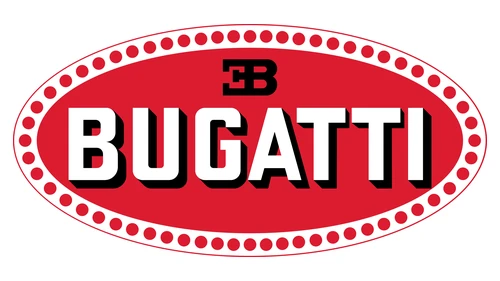
The first Bugatti logo is the badge fitted to the Type 13 at the end of 1909. It is flat, with heavy white capitals, a black shadow behind the letters, the black EB above and 60 red dots on a white border. Some timelines show a light-gray frame here, but Bugatti describes the border as white.
The image is a modern redraw of that design, not a photo of a 1909 part. Bugatti’s archive photos show the same oval on classics such as the Type 51 and the Type 35T.
Around 2007: A Refined Flat Badge
Logo archives date a refined drawing to around 2007. It stays flat but gets a darker gray band carrying the red dots, a thinner shadow under the letters, wider letter spacing and a brighter red.
Bugatti has not published a date for it, and the archives list it as in use until 2022, overlapping with the 3D version below. The drawing shown also comes from a logo archive, so treat its fine details as approximate.
Around 2015: The 3D Badge
The next rendering, which the archives place around 2015, adds depth: gradient shading on the red field, a frame that looks like silver, darker red dots and a heavier shadow on the letters.
It mirrors a real change to the physical badge. Work on the Chiron’s Macaron began in 2014. The result was 14 mm wider and 8 mm taller than the Veyron’s, with the lettering and dots on one enameled plane and the background almost 2 mm lower, which gives it genuine depth.
2022: The BUGATTI Wordmark
The new Bugatti logo of 2022 is a wordmark: BUGATTI in flat capital letters in a custom condensed sans-serif. The main version has no oval, no dots and no EB.
Shown in black on white, it is the black-and-white Bugatti logo many people look for, although the 2022 palette also adds a new Bugatti Blue.
2022: The EB Monogram as a Brand Mark

Next to the wordmark, the 2022 identity uses the EB initials on their own. Bugatti treats the EB as part of its heritage and uses it to mark the brand beyond the cars themselves. Design coverage of the launch reported that the monogram itself was left unchanged.
The New Bugatti Logo: 2022 Corporate Identity
Bugatti presented its new corporate identity on July 25, 2022, in Molsheim, built on the line “Create the Incomparable.” The branding consultancy Interbrand created it with Bugatti and also developed the new typography.
Three things changed: the corporate wordmark, the typeface and the color palette. The typeface draws on the original Bugatti lettering and on French typography. The new Bugatti Blue, Bugatti says, refers to the brand’s French origins. One design-press report linked it to traditional French Racing Blue, but Bugatti’s own announcement does not say that.
Alongside the new slogan, Bugatti restated Ettore’s own motto: “If comparable, it is no longer Bugatti.” The rollout started with the logo on social media, stationery and a new event setup, and parts of it were already in place at dealers. The timing followed a change of ownership: Bugatti Rimac had begun operating on November 1, 2021.
What the rebrand did not do is retire the red oval. It replaced the logo Bugatti uses for its communication, and it kept the EB.
Wordmark vs Macaron: Which Bugatti Logo Is Which?
The two logos now do different jobs. The wordmark stands for the company. The Macaron is the Bugatti logo on the car, and reports on the launch said it would stay there.
| Corporate wordmark (2022) | Macaron badge | |
|---|---|---|
| Where it appears | Social media, stationery, events, dealers | The radiator of the car |
| What it looks like | Flat capital BUGATTI, no oval, no dots | Red oval, white BUGATTI, black EB, 60 dots |
| How it is made | Digital typography by Interbrand | Handmade from sterling silver and enamel on modern cars |
| Status | Corporate logo since July 25, 2022 | Not retired by the 2022 rebrand |
The Macaron: The Silver Bugatti Emblem on Every Car
The Bugatti emblem on a modern car is solid silver. The Macaron on the radiator is made from 970 sterling silver and enamel, by hand, by Poellath, a family-owned embossing firm founded in 1778 in Schrobenhausen, Bavaria.
Poellath has made Bugatti’s emblems since 2003, starting with the Veyron 16.4, and is said to be the only company able to produce the badge with its 3D enamel effect. The enamel is now lead-free. The older type was about half lead.
Red is the standard color of the Bugatti badge. Only a very few cars, such as the Chiron Noire and the Chiron Super Sport 300+, wear the Bugatti symbol in black.
Macaron by the Numbers
| Detail | Figure |
|---|---|
| Material | Solid 970 sterling silver with enamel |
| Weight | About 150 g of silver; 159 g with enamel and fastening screws |
| Labor | About 20 skilled workers, roughly 10 hours spread over several days |
| Embossing | Several passes at up to 1,000 tonnes |
| Enamel | About 0.5 mm thick, fused at 750-900 °C |
| Lettering | Raised 2.1 mm from the base |
| Dots | Enameled and finished by hand |
The figures come from Bugatti’s press release on the badge, dated October 15, 2020.
Bugatti vs Lamborghini Logo: How to Tell Them Apart
The two logos share nothing. The Bugatti logo is a horizontal oval with initials and dots. The Lamborghini logo is a shield with a bull. If a supercar badge shows an animal, it is not the Bugatti car logo.
| Bugatti | Lamborghini | |
|---|---|---|
| Shape | Horizontal oval | Shield |
| Symbol | EB initials and 60 dots | Bull |
The Company Behind the Bugatti Symbol
Bugatti is a French car brand. Ettore Bugatti founded Automobiles Ettore Bugatti in 1909 in Molsheim, Alsace, which was then part of the German Empire and is now in France.
Ettore died on August 21, 1947. His son Jean had died in 1939, so there was no heir to take over. The original company stopped building cars in 1952 and was sold to Hispano-Suiza in 1963, which wanted its aircraft-parts business and built no Bugatti cars.
Romano Artioli revived the brand in 1987. In 1998 Volkswagen took over the Bugatti name, and on December 22, 1998, it set up Bugatti Automobiles S.A.S., a wholly owned French company. The hypercars that followed, the Veyron and the Chiron, carry the red oval on their radiators.
Frequently asked questions
Why is the Bugatti logo EB?
EB stands for Ettore Bugatti, who founded the company in 1909 and put his initials on the badge from the start. The same two letters later appeared in the name of the EB110, the supercar built in Italy in the 1990s by Romano Artioli's Bugatti Automobili. So if a car carries an EB logo, it is a Bugatti.
Does the Bugatti logo have a hidden meaning?
No hidden meaning is documented. Bugatti explains only what anyone can see: the founder's initials, the three colors and the 60 dots, and it presents even the dots as legend. Secret codes, number games or messages attributed to the Bugatti logo come from fan and logo websites, not from the company or its archive.
Is a Bugatti a Lamborghini?
No. Bugatti and Lamborghini are two separate carmakers with separate histories: Bugatti was founded in Molsheim, Alsace, in 1909, while Lamborghini is an Italian brand. They were sister brands inside the Volkswagen Group from 1998, with Lamborghini held through Audi, until Bugatti moved into the Bugatti Rimac joint venture in 2021.
Is Bugatti a French or Italian car?
Bugatti is French. It has been based in Molsheim, Alsace, since 1909. The Italian link comes from two places: founder Ettore Bugatti was born in Milan, and from 1987 the brand belonged to Romano Artioli's Italian company, Bugatti Automobili S.p.A., which built its cars in Campogalliano until it ceased operations in September 1995.
Is Bugatti still owned by Volkswagen?
No. Volkswagen owned Bugatti from 1998 until November 2021, when Bugatti Rimac took over, with Rimac Group holding 55% and Porsche AG 45%. On September 9, 2026, a consortium led by HOF Capital completed its purchase of Porsche's stake, so no Volkswagen Group company owns part of Bugatti today. Rimac Group remains the majority shareholder.
Does Bugatti still use the red oval badge on its cars?
Yes, as far as published sources show. The 2022 rebrand changed the corporate logo, not the car badge, and design-press coverage of the launch reported that the red Macaron would stay on every model. Two years earlier, in 2020, Bugatti itself had described the Macaron as the badge on the horseshoe radiator of every Bugatti.