Key facts
- Years active
- 1929–1937
- Founded by
- Errett L. Cord
- Country
- United States
- Headquarters
- Auburn, Indiana, United States
- Parent company
- Cord Corporation
- Famous models
- L-29, 810, 812
Brand Overview
Cord was a luxury automobile brand that operated between 1929 and 1937. The brand was created by Errett Lobban Cord as part of the Cord Corporation, a holding company that also controlled the Auburn Automobile Company. Manufacturing took place in Auburn and Connersville, Indiana, during the late Art Deco and Streamline Moderne period.
The company focused on innovative luxury vehicles. Its two main model lines incorporated advanced engineering features that set Cord apart from contemporary luxury marques such as Cadillac, Packard, and Duesenberg.
History and Timeline
Cord was founded on December 28, 1929. The brand introduced its first model, the L-29, as the first American front-wheel-drive production car. Production of the L-29 continued until 1932, with approximately 4,400 units sold before the model was discontinued due to the Great Depression.
In November 1935 the Model 810/812 design was unveiled at the New York Auto Show. Production of these later models ran from 1936 to 1937. The company entered bankruptcy and ceased operations on December 23, 1937. A single prototype with grille and transmission modifications was built in 1938.
- 1929: Brand founded and L-29 introduced
- 1929–1932: L-29 production period
- 1932: L-29 discontinued
- 1935: 810/812 design unveiled
- 1936–1937: 810/812 production period
- 1937: Company bankruptcy and closure
Cord Logo Evolution
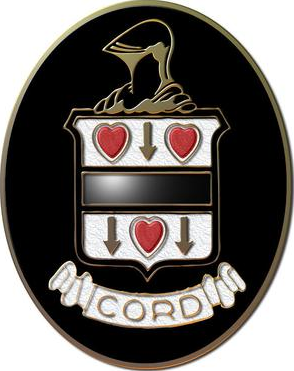
1929-1937: Cord Radiator Emblem
The radiator emblem remained the consistent visual identity for the entire Cord brand from founding until closure. This emblem was based on the Cord family coat-of-arms and was used on both the L-29 and the 810/812 models.
- Design: Knight’s helm at top, central shield divided by black line, two hearts and arrow in upper section, two arrows and heart in lower section, banner with text CORD at bottom
- Colors: Multi-color metal plate
- Changes: No documented redesigns during the active brand period
- Context: Served as primary brand identifier on luxury vehicles and reinforced premium positioning
The Cord emblem appeared on radiator grilles throughout production. Its heraldic design connected the automobile brand to traditional family heraldry while marking the vehicles as products of the Cord Corporation.
L-29 Model and Innovations
The L-29 was launched in 1929 as the first American production car with front-wheel drive. This engineering choice allowed a lower vehicle height because it eliminated the need for a rear drivetrain and permitted a straight frame. The model featured a Lycoming 301 cubic inch inline-8 engine and elegant proportions with a 137.5-inch wheelbase and 61-inch sedan height.
Its low-profile styling influenced later competitors, including 1930 Chrysler models. The Cord car symbol on these early vehicles helped establish the brand’s reputation for technical innovation.
810/812 Models and Design Legacy
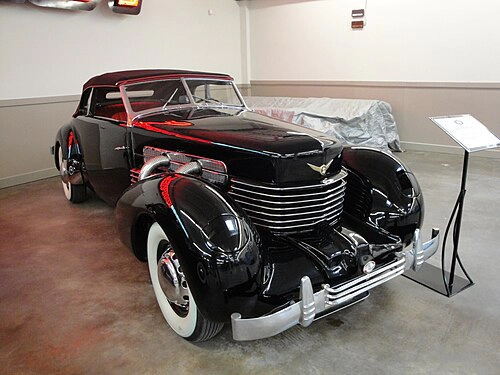
Gordon M. Buehrig designed the 810 and 812 models introduced in 1935. These vehicles featured front-wheel drive with independent front suspension and placed the transmission ahead of the engine, removing the driveshaft tunnel. The absence of running boards created a sleek, low-slung profile.
Distinctive horizontally louvered grilles earned the design the “coffin nose” nickname. The squared-off front end and hidden retractable headlamps became defining visual traits. A Lycoming V8 engine producing 125 horsepower powered the cars, paired with an electrically selected semi-automatic pre-selector transmission.
The Cord car logo remained unchanged on these advanced models, maintaining visual continuity while the engineering and body design pushed luxury automotive boundaries in the 1930s.
Visual Identity and Cord Symbol
The Cord symbol took the form of a radiator emblem modeled after Scottish McCord heraldry. This metal plate was attached to the radiator grilles of all production vehicles. Its consistent use across both model generations strengthened brand recognition during a period of rapid automotive innovation.
The emblem featured heraldic elements that communicated heritage and prestige. As a luxury brand, Cord used this distinctive badge to stand alongside established competitors while introducing groundbreaking features such as front-wheel drive and hidden headlamps.
Legacy
Cord’s active period ended in 1937 with bankruptcy. The brand left a lasting impression through its pioneering use of front-wheel drive in American production cars and its streamlined, innovative designs. The Cord badge and distinctive styling cues continue to represent a brief but significant chapter in luxury automotive history from the interwar era.
The radiator emblem remains the most recognizable element of the brand’s visual identity. Its design based on the Cord family coat of arms provided a unified symbol across the L-29 and 810/812 eras, representing both technical achievement and luxury positioning.